Tuesday, January 31, 2006

The Aftermath

While in the heart of the Research Triangle (Raleigh, Durham, and Chapel Hill for the uninformed), the MUCH-TALKED about trade finally happened. Since we've already addressed the perceptions about Coco, the numbers of Jason Michaels, and the addition of Andy Marte - let's look at each of the positions that were affected by the trade, briefly, and see how the deal affects the Tribe in 2006.

Catcher
Josh Bard's deficiencies with the bat had made him an unsatisfactory backup for Victor (as evidenced by his 83 AB's last year), with Wedge almost afraid to give Vic a day off because of the steep drop-off. Shoppach - who may develop into a legitimate future regular - has power, leadership skills, and defense as his strengths. Shapiro's comments that Shoppach may play C, while The Stick moves to 1B were nothing less than shocking. Can you imagine Shapiro saying similar things about Bard?

While I know very little about Shoppach (outside of his minor league numbers), I do know that Bard was an offensive liability, who seemed to reach his ceiling before the sports hernia. The Indians thought as much, obviously, bringing Einar Diaz and Tim Laker back into the fold to press Bard. Those players, still, will press Shoppach to be backup C, but it seems that Shoppach seems destined to make the team as the backup C.

This represented a very small part of the trade, but we've all seen what Shapiro has heisted before in throw-ins (Coco).

Outfield
Speaking of Coco, this seems to be the hot-button issue for most fans: the trade of an established portion of a successful team to improve the team for the future. But, examining the comments by Shapiro, the Indians never SOUGHT to deal Coco Crisp. They were approached by a number of teams (Arizona and New York were two others, among many) to deal Crisp to play CF. In Shapiro's estimation, he would only make a move if he were "blown away" by it.

Before we go further, consistent readers of the site know that I entered 2005 with a very low estimation of Coco, essentially that he was a glorified 4th outfielder. Yet Coco grew on me. Perfect, he was not. But his insertion into the 2 spot (with Grady and Jhonny around him) solidified the lineup. I felt that the Indians, in the long term, could handle his low power numbers (at a corner OF position), noodle for an arm (I was once in the left field bleachers when he threw the ball, no lie...10 feet), and his erratic baserunning. Warts and all, I thought that the Indians had enough talent elsewhere that Coco could be a nice complementary player on a good team.

But Coco was miscast as a LF, and had more value to another team at his natural position of CF than to the Indians. I have little doubt that the Indians would have upgraded LF (from the minors or FA) at some point in the next few years, and that is why Coco is gone.

I hope that Coco does well in Boston, with the aggressive media and their lack of patience, but I think that he's going into a situation where a lot is expected of him, as a great CF and a leadoff hitter. We'll see how Coco holds up (and I hope that nobody sees him as Johnny Damon's equal in 2006), but I've been surprised before.

On the Michaels front (who was referred to recently in the media as Shawn Michaels, thus the nickname "The Showstopper"), again I hope that the media doesn't attack him for every inconsistency in his game (though it WILL happen). Michaels is what he is, a player who has been relegated to being a 4th outfielder, either because of the impatience of the Philly front office or because he is a platoon player.

I think that Michaels, with an occasional Hollandsworth sighting, can make up for Coco's bat. All indications are that HBK is an above-average defender with a good arm, so he should fill in well in LF (which, with SuperSizemore to his left, is made easier). The Indians truly don't need that much from Michaels (again, he is a complementary player), but I sincerely hope that the Coco backlash doesn't adversely affect him, if by chance he starts slowly.

Overall, I'm OK with this trade-off and I can't figure out why I'm so blase about it. Coco was never that great of a player to me, and Michaels seems like a stopgap.
Maybe that's all that Coco was.
Maybe I'm giving Shapiro too much credit.

When all is said and done this season, don't be surprised if Grady Sizemore is the only OF who begins and ends the season as a starting OF.

Bullpen
The Tribe gave up two arms (Rhodes and Riske) in the trades, bringing Mota into the fold. By looking at the 2005 numbers (when Rhodes and Riske both did extremely well), this seems to be a crushing blow. However, if memory serves me correctly, neither Rhodes or Riske pitched extensively during the chase of the White Sox. Betancourt, Cabrera, Howry, and Wickman seemed to pitch every single night (with an occasional Sauerbeck sighting).

Shapiro is using that thinking to replace Howry with Mota. Howry got closer money to go Chicago (and his robotic ways will be missed), but in the end he was overpaid by a team desperate for bullpen help. Mota represents the replacement for Howry and allows the 'pen to shake out this way:
Wickman
Mota
Betancourt
Cabrera
Sauerbeck
Miller
Davis/Stanford/Tadano

Bullpen is a fluid concept (and don't discount B-Phil for another bullpen arm in Spring Training), and the lesson of 2004 still sits in Shapiro's memory. With that being said, there's no way to predict how individual bullpen arms will perform from year to year.

Shapiro has eaten enough Tums and Pepto to make sure the best bullpen of 2005 won't be far off the pace.

3B
This is the key to the whole trade (and more than simply the obvious acquisition of Andy Marte): Depth. Aaron Boone vastly underperformed in 2005 and despite all of the projections and the "don't worry about Boonie" comments that came out of the Front Office, the reality remains that behind Aaron Boone...there is nobody. The Indians farm system is full of players who don't project to the Majors for a while (if at all), and that had to have scared Shapiro.

If Boone started 2006 like he started 2005 (without the excuse of the knee), you're sitting on a HUGE hole in the lineup every day with no alternative. Enter Andy Marte.

People have talked ad nauseum about Marte and his ability and his great numbers at high levels in the minors at a young age, but Marte offers the Indians something they desperately lacked - insurance against another slow start by Boone. If Boone starts slow, and Marte fast, Marte could be called up to patrol the hot corner, with Boone becoming the utility IF (he has played SS as recently as 2003). Boone would still provide that attitude and leadership that Wedge and Shapiro reference so much, while being able to take Marte under his wing.

Of course, Boone could come out play very well and make this all a moot point. But until he does, the Indians needed to cover themselves. And they did so very well, by acquiring Marte.

2006 Effects
I don't think that this trade effects the team as significantly as most do. I think that The Showstopper will fill in adequately for Coco and that Mota and Shoppach will fill their roles admirably. The big effect of this trade to me (which some may disagree with) is that the quality of players one phone call away from the Jake is astounding.

All of last year, people moaned and howled about Boone, Broussard, and Blake. Here's some news: with the acquisition of Marte, the Indians have Marte, Garko, and Gutierrez nearly ready for the Majors. These players are not afterthoughts. They are nearly ready for the Majors and should contribute in 2006.

Sitting at a bar with a Yankee fan around Christmas, he was telling me that the last great Yankee team was the 2001 team. The reason that it was great was that it held to a basic premise - a team wins with strong starting pitching, a solid bullpen, 5 "core" players and the remainder of the lineup and roster that knows their roles.

The Indians are close.
The pitching is in place. The bullpen is in place. The "core" players are close (Grady, Jhonny, Vic, Hafner) with the great possibility that Marte, Garko, or Gutierrez will develop into that 5th, and the complementary players ready to play their role.

I'm excited, but guardedly so. This team needs to continue to develop, but the youth and talent are hard to ignore.

Sorry about the long post, but it's been a while.

Let Shapiro do his job and give him the benefit of the doubt...he's earned it.

Thursday, January 26, 2006

Sitting Pretty

The roller coaster ride continues, with Jason Stark reporting that the Coco deal is rapidly losing steam. However this all plays out, one has to believe that Shapiro is playing this situation nearly perfectly.

Knowing that the Red Sox are desperate for a CF/Leadoff Hitter, he asked for their top prospect (and possibly the top prospect in baseball) along with players that would upgrade the bullpen and backup catcher positions. To cover himself, he was acquiring a replacement for Coco, whether it be in the form of Kearns or Michaels. Whether either of those players would improve or hurt the 2006 team is up for debate, but, be aware - the outfield won't have Todd Hollandsworth AND Kasey Blake in it. If anything goes down, we have plenty of time to REVIEW the trade, rather than engage in pure speculation.

Regardless, the Indians are in the best spot of the four teams alleged to be in on these deals:
The Red Sox still need a CF and a SS and have about 7 starters on their roster, meaning they'll make a move at some point before the start of the season.
The Reds' new owner finally got rid of the GM who felt that it was better to have 5 OF than 1 decent Starting Pitcher.
Kearns is the odd man out and WILL be dealt to get pitching.
The Phillies have 4 outfielders and a hole in the bullpen.

The Indians could have the answer to all of these questions, but guess what? The Indians' roster looks pretty good right now and Shapiro would have to be blown away to make a move. Not a bad position to be in.

One interesting thing about this Coco outcry that struck me is the amount of people that were saying, "this team won 93 games last year, let's allow them to mature." Isn't that what we've patiently been saying all offseason?

And as for the people who were incredulous about trading a "core" player on the team:
We're talking about Coco here - not Grady, or Jhonny, or Victor, or Travis, or C.C., or Cliff, or one of the young guns. We're talking about a LF who will hit about .290-.300 every year with 15-20HR and 65-75 RBI. This is what we're so unwilling to give up.
We're talking about Coco here. What we talking about? Coco? C'mon man.
(Sorry, I slipped into Allen Iverson mode, there)

Seriously, though, what we can deduce from the rumors (true or untrue) is which players the Indians are willing to move (Coco, Riske, Bard, Rhodes, Westbrook) and where they would like to improve in the organization (LF, RF, bullpen, 3B depth, backup C). Can anyone argue with that?

Due to a trip south of the Mason-Dixon Line (Raleigh) to catch some ACC action (UNC-Arizona in the afternoon, Duke-UVa in the evening), I'll be out until Sunday. If anything happens, I'll try to get to a computer to have some comment. I'll be with some Cincitucky Reds fans, so it will be interesting to hear some different perspectives.

What we talkin' 'bout here? Coco?

Tuesday, January 24, 2006

Back to Square One

The Philadelphia Inquirer is reporting Guillermo Mota has failed his physical, putting the brakes on the Coco deal, and thus the Rhodes deal.

While this is a setback, I don't think that this is a deal-breaker.

And with the firing of Dan O'Brien in Cincinnati, Austin Kearns could once again be in play to upgrade the Tribe outfield. O'Brien reportedly turned down a Westbrook for Kearns deal (which I'm happy for), but the Tribe may be able to package some players to get Kearns to play RF or LF. Whether the Michaels deal even happens after that is up for debate (though I wouldn't mind it).

I don't think that this Coco move to Boston is dead, just be assured that there won't be as many leaks or hand-wringing in public when talks resume (and they will). Negotiating through the media is not the way that Shapiro likes to conduct his business and, last I checked, he's still holding the chip that Boston can't seem to take their eyes off of.

With all of the talk of these Boston prospects, I thought I'd pull the scouting report from Rotoworld on the AL East Prospects (Marte is Boston's #1 prospect, Shoppach is #7):

#1 Andy Marte - 3B
ETA: April 2007
Marte's bad 47-at-bat stint for the Braves should hardly qualify as a setback, not when he was so productive in Triple-A as a 21-year-old. The only real source of concern now is the mysterious right elbow injury, which came to light after he was traded to Boston for Edgar Renteria. His agent dismissed the report of him possibly requiring Tommy John surgery as nonsense. Even if Marte did need the surgery and missed 2006 as a result, he’d still be a fabulous prospect. His defense at third base, once a weak point, continues to improve, and he’ll be a .280 hitter with 30 homers and 60-70 walks per year in his prime. Another three to six months in Triple-A should be sufficient.
Reports have Marte on his way to Cleveland for Coco Crisp. It’d be an incredibly short-sighted move for Boston.

#7 Kelly Shoppach- C
.253/.352/.507, 26 HR, 75 RBI, 116/46 K/BB, in 371 AB in AAA
It hardly seems fair, but Shoppach’s embarrassing showing in 15 at-bats for the Red Sox last season seemed to counter what good he did by hitting 26 homers and finishing with an 859 OPS in 371 at-bats in Pawtucket. There didn’t appear to be much interest in him in trade talks over the winter, and now the Red Sox are prepared to go with John Flaherty rather than try Shoppach as the personal catcher for Tim Wakefield this year. Shoppach still figures to be a long-term regular. He’s solid enough defensively that he’ll never have to hit for much of an average to be one of the game’s top 30 catchers. With Jason Varitek signed through 2008, Shoppach will again be a candidate to go in an in-season deal this year.

Comparatively, Baseball America had Fernando Cabrera as the Indians' #7 prospect, so we're not talking about two marginal prospects. Shoppach would likely start the season as Vic's backup and Marte would start in AAA, with all opportunities to progress to the Majors quickly.

Just a little background on these names that sometimes feel like nothing more than names.

Stay tuned as pitchers and catchers report in mid-February, and at the rate that we're going, there's no telling what could happen.

Monday, January 23, 2006

Still in Limbo

With the Coco trade still all speculation, Ken Rosenthal has weighed in. What he's reporting (and he's usually right, if not real close) is the same initial trades to go down that are listed in Sunday's post.

Before I get into the moves fully (because they still haven't happened), I want to take a step back and look at some numbers for the players that seem to be the most oft-mentioned in the moves.
First, the outfielders in question and their 2005 stats:
Coco Crisp
-.300/.345 OBP/.465 SLG/.800 OPS
-16HR/69RBI/594AB
-44BB/81K
Jason Michaels
-.304/.399 OBP/.415 SLG/.814 OPS
-4HR/31RBI/289AB
-44BB/45K
Not too far off of each other, except that Coco had double the AB's and a worse K/BB ratio. Michaels is also superior in OBP, which could translate into his insertion to the #2 hole (if the trade happens).

Next, the relievers and their 2005 stats:
Arthur Rhodes
–43 1/3IP/1.04 WHIP/2.08 ERA
-43K/12BB
Guillermo Mota
–67IP/ 1.44 WHIP/4.70 ERA
-60K/32BB
Rhodes' numbers look a lot better, but the numbers were reversed in 2004. Truth be told, relievers (outside of Mo Rivera) are hard to predict from year to year.

Up to this point, the players involved look pretty similar. And now you get to the reason that the Indians are making this trade and his 2005 stats in AAA:
Andy Marte
-.275/.372 OBP/ .506 SLG/.878 OPS
-20 HR/70RBI/389 AB
-64BB/83K
Now I know what you're saying, "he's just a 21 year old prospect at AAA," but consider the comparable stats of a 22 year old in AAA in 2004:
Jhonny Peralta
-.323/.382 OBP/.489 SLG/.871 OPS
-15 HR/86 RBI/560 AB
-55BB/129K
So, imagine Peralta being a year ahead of where he is now. Do you try to make that acquisition?

I don't know if this trade helps or hurts the Tribe in 2006. If it does either, it's not that big of a difference. The difference is Marte, the middle of the order RH bat that doesn't come around very often.

When you have a desperate team willing to overpay for a player, you take advantage, regardless of where you finished last year or where you project this year. This deal makes the Indians a better, deeper team for a long time.

If the deal goes down, I'll get a lot more in-depth. Right now, Jack Bauer's about to save the world (again).

Sunday, January 22, 2006

Not So Fast, My Friend

Just after I put up a post that the roster looks set, the Boston media reports that the Coco deal is done. Then, just to give it some validity, ESPN is reporting the same thing.

It still isn't clear which players are going where, but this is what it looks like:
CLE gets:
Andy Marte - 3B
Jason Michaels - OF
Guillermo Mota - RP

BOS gets:
Coco Crisp - OF

PHL gets:
Arthur Rhodes - RP

These principals could certainly change, but this is the most widely reported synopsis of the exchanges.

The naysayers will say that this is an indication that the Indians are "not going for it in 2006", but essentially you're replacing Crisp with Michaels and Rhodes with Mota while acquiring a top-flight prospect in Marte (who, incidentally, was traded for a perennial All-Star SS, straight-up, just a few months ago).

More on all of the stats and ramifications as the trades become clearer, but this is what it looks like right now.

Excellent coverage in the PD on it. Oh wait, it must be right next to the article about Modell and Voinovich. Unbelievable that the local paper completely whiffs on this.

Thursday, January 19, 2006

25 Man Projection

While we're still 3 1/2 weeks away from pitchers and catchers reporting, it looks like the 25-man roster is essentially set:
Starting Lineup
Victor Martinez
Ben Broussard
Ronnie Belliard
Jhonny Peralta
Aaron Boone
Coco Crisp
Grady Sizemore
Casey Blake
Travis Hafner
This is essentially the lineup that scored the 4th most runs in the AL, despite the deficiencies at 1B and RF. The Perez signing and the push for Garko to get experience at 1B indicates that if Broussard starts off slow, he could be displaced (particularly at the $2.4M he'll probably get in arbitration). Wedge and Shapiro seem content to give Blake another shot in RF, which should play itself out by June. If Blake stays in 2005 form (as opposed to his consistent 2004), the ultimate answer to RF may come via trade.

Bench
Josh Bard
Eduardo Perez
Ramon Vazquez
Todd Hollandsworth
This is an area that Shapiro said needed an upgrade, but there didn't seem to be one. Bard and Vazquez remain, while Perez replaces Hernandez. The thought was probably to get a RF, which would allow Blake to come off of the bench, which is where he's probably best suited and may end up. Hollandsworth has more experience than the other 4th OF candidates, as well as not needing the consistent ABs that Dubois and Gutierrez need in Buffalo.

Rotation
C.C. Sabathia
Jake Westbrook
Cliff Lee
Paul Byrd
Jason Johnson
Obviously, we've swapped Millwood and Elarton for Byrd and Johnson (for a lot less years and $), but the rotation still looks very solid. Assuming that C.C. pitches how he did in the 2nd half of last year (like he's finally figured it out) and the other pitchers post numbers close to their average, this remains a strength in a strong pitching division.

Bullpen
Bob Wickman
Fernando Cabrera
Arthur Rhodes
Rafael Betancourt
David Riske
Matt Miller
Scott Sauerbeck
The re-signing of Riske rounded out the bullpen, which essentially replaces Howry with Cabrera. When the bullpen is viewed from that perspective, it seems solid. The major question, though, lies in the back with Sticky Wicky.
Personally, I'm of the belief that Wickman, by his guile and determination, could save games pitching with my arm. It wouldn't be pretty, but it's not very pretty now. Regardless of style points, you cannot argue with Wicky's successful results of 2005.
The big fear is a repeat of 2004 Spring Training, when Wickman went down and the bullpen fell apart. The main difference between that pen and this one is that Arthur Rhodes (or Betancourt) may be able to hold down the fort if Wickman were to go down, whereas Jose Jimenez and Scott Stewart folded like a house of cards (a nod to Bud Shaw - King of Analogies).

On the Outside Looking In
Brandon Phillips (out of options)
Jason Davis (1 option left)
Danny Graves (minor-league contract)
Steve Karsay (minor-league contract)
Lou Merloni (minor-league contract)
B-Phil will likely be dealt during Spring Training and he may be packaged with David Riske, based, ironically, on the early reports on Graves and Karsay. If either is pitching well, they could fill that 6th inning role, allowing the Tribe to trade Riske to a team (upon entering Spring Training) that realizes, too late, that their bullpen is going to be a problem.
Davis (as Eric Wedge told WTAM, prior to the Art Modell interview, today) will pitch in the bullpen in Buffalo and try to master the preparation and routine of pitching out of the bullpen. With his live arm, let's hope that JD can get it all pulled together so he can contribute in Cleveland, and not elsewhere.

Would have to force their way into the lineup
Jason Dubois
Franklin Gutierrez
Ryan Garko
Andrew Brown
Fausto Carmona
Jeremy Sowers
As stated earlier, Dubois and Gutierrez will probably start in Buffalo, though Dubois could hit his way onto the team this Spring. The HUGE drawback to Dubois is his poor fielding, which prevents him from being the ideal 4th OF. Garko will start in Buffalo to get reps at 1B, where he will probably continue to crush the ball. Once his defense is adequate, I expect to see the Stanford grad at the Jake. Andrew Brown has one option left (thanks to an injury exception) and could be another option in the bullpen (along with Davis, Graves, and Karsay) to give the Tribe depth through the long regular season. Carmon and Sowers (the 2 young pitchers Wedge specifically mentioned as "ready to contribute in 2006") will start in Buffalo and should be a phone call away from a spot start at the Jake.

Thanks to the fellas at Let's Go Tribe for help on options, and let's hear some pre-Spring Training thoughts.

Wednesday, January 18, 2006

East Coast Family

The trade of Brian Tallett to the Toronto Blue Jays for a guy named Bubbie brings an end to the BT Boys Era. With Billy Traber trying to make the Washington Nationals this spring and Tallett trying to do the same in Toronto, it got me to think how these two lefties were once seen as having the potential to be major cogs in the Indians' rotation for years to come.

Both started a few games in 2003 (Traber - 18, Tallett - 3) as they came to the Majors with another minor league southpaw, Cliff Lee (9 starts in 2003). Traber was the most ballyhooed, coming in the Alomar deal; with Lee seen by some as a throw-in for Colon, while Tallett was a home-grown prospect. A mere 3 years later, the 3 players fall perfectly into the East Coast Family Model (which those not into the hip-hop scene of the early '90s may not grasp completely, but should get the concept).

The East Coast Family Model
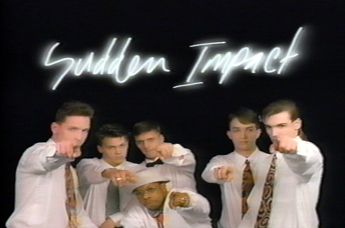
Michael Bivins, member of New Edition and Bell Biv Devoe, launched his New Jack Swing sound with the "Motownphilly" video from Boyz II Men in 1993. In the video were pictured his 3 main acts: Boyz II Men, Another Bad Creation (ABC), and Sudden Impact.
Another Bad Creation burst onto the scene with a few hits and were seen as another Jackson 5, or at least New Edition. but after their initial success, they fizzled and disappeared.
Boyz II Men put together a solid career with singles and albums that consistently performed well, turning into a force in the music business.
Sudden Impact, the oft-forgotten white band of the group, never even recorded an album ; which, for the fans of the East Coast Family, fell under the category of falling below expectations, regardless of how high or low they may have truly been.

So, how does this ridiculousness relate to the Brian Tallett trade?

The three lefties that hit Cleveland in 2003 were all seen as potential fixtures in Jacobs Field, some coming with higher expectations (Traber) than the others. Each of these players followed the road of one of the bands of The East Coast Family Model:
Traber - ABC - After a promising 2003, including the memorable one-hitter against the Yankees, Traber disappeared from public view. Partly from injury and partly from his (alleged) avoidance of criticism, Traber is now toiling to find his footing in the NL.
Lee - Boyz II Men - Building on his initial success of 2003 (3-3, 3.61 ERA), Lee had a phenomenal 2004 and 2005, leading most to believe that he will remain a force in the rotation.
Tallett - Sudden Impact - Never really able to find a home in the rotation or the bullpen and plagued by injuries, Tallett eventually became a 28 year old pitcher without a track record or a specialty. Hopefully, he'll catch on as a LOOGY somewhere, or he'll fade into oblivion.

Not bad, eh? But, you're saying, "that's an isolated situation made to fit into the parameters". Or is it?

Also in 2003, 3 young outfielders made their debuts in Cleveland, slotting perfectly into the ECFM:
Jody Gerut - ABC - After a stellar 2003 campaign, in which he played in 127 games and won the Sporting News' Rookie of the Year, Gerut succumbed to injuries and ineffectiveness. Eventually, he was traded to Chicago, then Pittsburgh this past year.
Coco Crisp - Boyz II Men - Easily the least-hyped prospect of the group, Coco played 99 games in 2003 and has since managed to stay healthy and be productive in the Cleveland lineup. After fending off many challengers, Crisp may be looking at a long-term deal before Spring Training.
Alex Escobar - Sudden Impact - The Mets' top prospect, who came over in the Alomar deal, played in 28 games in 2003. Despite his gaudy Minor League numbers and rocket arm, Escobar was eventually given up on and has bounced around the league, unable to stick on a roster.

But there's more from 2003, regarding some RH starters:
Jason Davis - ABC - Davis started 27 games in 2003 and was thought to be the Indians' #2 starter of the future, right behind C.C. for years to come. But Davis has been unable to relive that success and has bounced back and forth between Cleveland and Buffalo, the rotation and the bullpen, until this year where it looks like he will be starting in Buffalo again.
Jake Westbrook - Boyz II Men - Starting 22 games in 2003, Westbrook went into 2004 as the long man only to rattle off some of the more impressive pitching of 2004, forcing his way into the rotation. He has stayed in the rotation since, even signing a long-term deal before the start of the 2005 season.
Ricardo Rodriguez - Sudden Impact - Acquired as part of the Paul Shuey deal, Rodriguez started 15 games in 2003, but never really experienced much success in Cleveland or in Texas (where he was dealt for Ryan Ludwick).

So what does this inane model show us, other than that I have too much time on my hands? Essentially, that not every "can't-miss" prospect is a can't miss, just as not every Player To Be Named Later is a scrub. It takes time for the true value of a player to show himself.

How will the Indians young stud pitchers (Sowers, Carmona, Miller) fit into the model? Or the young outfielders (Gutierrez, Snyder, Dubois)?

Time will tell, but let's all agree on what we're looking for more of:
Boyz II Men...hey, you know what I'm saying.

Sunday, January 15, 2006

Sunday Tidbits

As usual, a few great items from Terry Pluto on a Sunday. Why the PD sticks with their "columnists" for all these years is one of the great mysteries to me.

Ken Rosenthal hit on an interesting comparison:
Consider this comparison: Pitcher A was 20-18 with a 3.70 ERA in 3282/3 innings over the past two seasons. Pitcher B was 19-16 with a 3.86 ERA in 3262/3 innings. Pitcher A, right-hander Paul Byrd, signed a two-year, $14.25 million contract with the Indians. Pitcher B, left-hander Jarrod Washburn, received a four-year, $37.5 million deal from the Mariners. Washburn, 31, is four years younger and left-handed, but is he worth $23.25 million more? Doubtful.

Why is it that every national media type (with the exception of the all-knowing Steve Phillips) seem to think that the Indians were one of the few teams this off-season who made good, low-risk deals as opposed to a risky, flashy signing? Meanwhile, the local guys just make fun of the Dolans and their "cheapness".

Everyone decries the fact that we didn't sign a needed "big bat". Last I checked, Hafner, Martinez, Peralta, and Sizemore are all still in the lineup. While (and maybe because) the power from "big bats" doesn't come from the traditional power-producing positions (1B, 3B, RF, LF), everyone seems to forget that the C, SS, CF, and DH are probably in the Top 5 in their positions in the entire Majors.

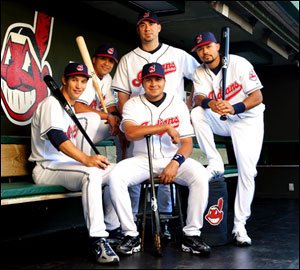
When you get down look at this picture:


And realize that ALL of these players (representing 5 of the 9 spots in the lineup) are under the Tribe's control until, AT LEAST, 2008. That's 3 more years.

Now do we feel a little better?

Wednesday, January 11, 2006

Tomahawks


Not much going on at the Jake, and still...the tomahawks are flying:

  • Good article by Ken Rosenthal on Coco Crisp's value and how other teams are going to have to bowl over the Tribe to get a deal done. Part of me still thinks that Coco may not be around when all is said and done, though I have nothing to back that up.
  • Bruce Sutter got elected into the Hall of Fame and every article that I saw leading up to the election showed the potential inductees (Sutter, Gossage, Rice, Blyleven, Jack Morris), which got me to thinking: What happened to the beards and mustaches of the past? I'm not talking a pretty Mike Piazza mustache or a well-manicured goatee. I'm talking Jim Rice's bushy mustache or Bruce Sutter's overgrown beard. I think that Wickman, for one, would look awfully tough coming out of the 'pen with the whole mountain man bushy beard working for him. Maybe he can't because he's bald. Seriously, though, I would love to see the return of the wild facial hair, if only because I could pass it off as cool to the wife (how many people shaved their head before Michael looked cool bald?) and not shave for a while.
  • With Eduardo Perez undergoing a physical, expected to sign any day and Shapiro's candid comments about Broussard, I got to thinking about Ryan Garko's defense. Shapiro said that Garko has only played one half of a season at 1B and doesn't need to be spectacular, he just needs to make the plays that should be made. If Broussard starts off slow (as he's prone to be streaky) though, I wouldn't be surprised to see Garko in Cleveland sooner rather than later due to Shapiro's effusive praise for his hitting approach and results. That is, of course, unless he has the John Kinsella Syndrome.
  • And what is John Kinsella Syndrome, you ask? The JKS is the inability to have the baseball move past one's ear in a throwing motion. Or, essentially, throwing like a girl. The JKS is named after one of the worst moments in one of the best movies around. Upon Kevin Costner's realizing that the catcher in his cornfield is his father and asks him to "have a catch", everybody gets choked up. Until, that is, when his father John Kinsella (a reputed former minor league catcher) short-arms his first throw, undermining all of the good feelings up to that point. The producers went to such great lengths to make sure that the baseball scenes seemed genuine with actors possessing athletic ability. Until they get to the watershed moment of the movie. Terrible, just terrible.
  • The JKS is also know to afflict Roy Hobbs' son at the end of The Natural and, more recently, Tom Cruise in War of the Worlds. Cruise, in particular is painful to watch, mainly because of his starmaking turn in All the Right Moves.
But I digress...
  • The Hollandsworth minor league deal basically gives the Tribe some depth if they don't acquire another OF. Hollandsworth is a decent 4th OF who, at the high-end, could turn into another Marty Cordova (as noted at Let's Go Tribe).
  • I don't know if anyone else is forced to watch The Bachelor because of marital ties, but the first episode of the new season was unusually enjoyable as one of the women told the guy that her "eggs were rotting" and she had entered her "reproductive phase". Surprisingly, she was not picked and, as the episode progressed and the wine kept flowing, she ended up looking like Jerri Blank from Strangers with Candy, but a little scarier.

Pitchers and Catchers report February 16th. Can you tell I'm ready?

Monday, January 09, 2006

Shapiro on Shapiro

Last week, Mark Shapiro appeared on More Sports with Les Levine and was surprisingly candid and open about last season, players on the Indians’ roster, and going forward:

On Available Free Agent Bats
Shapiro said that the team knew going into the offseason that there were very few quality bats available, which is why they pushed so hard for Giles and Nomar. Unfortunately, both turned them down for less money to stay on the West Coast. Shapiro essentially said that the most important aspect of a hitter for the organization is plate discipline, which is essentially minimizing K’s, and by having productive at-bats, which can be generally gauged by OPS. So, by looking at a player’s K/BB ratio and OPS, you can determine rather quickly if a player fits the Shapiro mold.
Preston Wilson and Craig Wilson, just to name two, seem to strike out too much to be considered worthwhile contributors. Casey Blake does too, but more on that later.

Shapiro knows that this team is one bat away, and that an experienced hitter would certainly help; but for now, he has to depend on the talented hitters already in the lineup having one more year of experience. He hopes that nobody had a “career year” last year, but realizes that throwing too much money at a player (look at Burnitz’s contract) does nothing to help the team.

On the Indian Way and Manny

When asked about Manny Ramirez, Shapiro almost bristled and said that no player on the Indians would ever be like Manny, a player with his own set of rules who plays when he wants to play. He said, instead, that the philosophy is “to win with a team, not with individual superstars.” He added that some current players may become superstars because of their talent, but their makeup would never cause a problem.
He specifically identified the Indian Way as filling the team with team players who respect each other while the front office identifies available value to contend every year.

When pressed on whether Manny would sell enough tickets to justify the trade, Shapiro essentially said that the Red Sox wanted Sizemore and Peralta without picking up any of Manny’s salary. Shapiro went on to say that Manny’s negatives outweighed his positives and he could never sell enough tickets to justify his inflated salary.
Do you think he’s tired of hearing this question? From the usually political Shapiro, this was serious stuff.

On Salaries, Attendance, and the AL Central
Shapiro addressed the fact that the Tribe would have the 2nd lowest payroll in the AL Central, but said that it has nothing to do with how much is spent; it is HOW that money is spent. He reiterated what we’ve heard for a while about attendance being the equalizer for the Indians that can level the salary discrepancy in baseball to get the Tribe more in line with the Central. He also said that no one player is going to sell tickets, but winning would. The hope is that the winning of last year will bring people to the Jake, which makes sense to me. In his words, “money doesn’t solve problems, good management does.”

Shapiro said that the Tampa Bay series was the only time that he was truly disappointed in the fan base in Cleveland. Pointing out that the games were played with a potential playoff berth on the line, the Indians played in front of a less than the ML average crowd. Granted, they lost those big games, but as someone who was at all of the games, I couldn’t agree more. I was just surprised that Shapiro was as candid as he was about that one, as he usually defaults to being overly complementary of Indians’ fans.

Shapiro acknowledged that the White Sox improved their team, adding the classic caveat, “on paper”. But he said that the additions of Vazquez and Thome certainly should make the Central more competitive. When asked what he would do to counteract those additions, Shapiro essentially said, “I can’t worry about them, I have to do what I can do to make the Cleveland Indians a better team. There are certain facets of the Indians that WILL be worse than they were last year, I just don’t know what they are right now. When I find out, I will do my best to fix them.”
He also noted that the division has gotten a lot better, comparing the 93 wins of 2005 that weren’t enough to make the playoffs to the 87 wins that carried the ’97 Tribe to the World Series. The balance of power has shifted in the AL, with the Central boasting 2 (if not 3) of the better teams.

On the Lineup
Shapiro acknowledged that Sizemore and Peralta may see a bit of a down year, compared to 2005, but also said that both players are so talented and exceeded expectations so fully last year (Peralta was the 2nd most productive SS in the Majors last year), he didn’t expect the drop-off to be steep. Pointing to both players even-keeled demeanor, he identified them as fixtures in the lineup for years.
But we already knew that. The real surprise came in his descriptions of the 4 B’s:
On Boone:
Boone’s 2nd half is more indicative of the player that he is, according to Shapiro. Remember that Boone was hitting about .195 in mid-May, so his 2nd half should serve as a model for what we can expect in 2006. Shapiro also said that Boone was signed to be a bottom 1/3 of the order hitter, and was never meant to hit 3, 4, or 5 in Cleveland. As usual, Shapiro praised Boone’s makeup and defense and essentially promised that Boone would be much improved in 2006. He made no mention of Boone’s wife, Laura Cover.
On Belliard:
When discussing how the strength of the Indian lineup was up the middle (Vic, Jhonny, Grady), Shapiro corrected Levine, who had said that the Tribe got “above average” production from 2B. Shapiro quickly jumped in saying, “our production at 2B is just average.” I agree, but it was surprising that Shapiro was that quick to NOT include Jelly in that grouping.
On Broussard:
This is where Shapiro really spoke honestly and candidly, calling 2006 a “make or break year for Benny in Cleveland.” He pointed out that Broussard has shown talent in spurts, lasting anywhere from 3 weeks to a half a season. Shapiro said that “we don’t need spurts, we need consistency.” He stated that Broussard had the talent to play in the Majors, as an “average defender”, and with the obvious talent that showed up in those spurts. But without that consistency, Broussard has to be protected with a RH bat. Enter Eduardo Perez.
I was shocked to hear Shapiro so down on Broussard, even though it is deserved. Normally, again, Shapiro goes out of his way to be positive and defend his players. This was a definite turn from that philosophy and practice.
On Blake:
Shapiro acknowledged that the pursuit of Giles and Nomar were in response to Blake having a bad 2005 at the plate particularly with Runners in Scoring Position, calling it a “big drop-off” after back-to-back “good” seasons. He said that Blake is ideally a phenomenal super-utility player, versatile and athletic enough to play RF, LF, 1B, and 3B. He called Blake “a big league player, because of his versatility; but RF is a position we’d like to upgrade offensively.”
Again, there were no huge revelations here, other than Shapiro being refreshingly honest and openly critical of a player who has his warts.

On the Bullpen:
Asked how the whole closer thing went down, Shapiro explained that the FA closer market next offseason is abysmal, forcing the Tribe to look for a multiple year fit at closer. Since Wickman had essentially told the Indians that he was a one-year solution, Shapiro went after B.J. Ryan (who felt the Indians were a better fit, but offered less money) and Hoffman (to whom the Indians offered more money, but the Tribe didn’t play in San Diego). When those players rebuffed the Tribe, Wickman was more than happy to return (for his probable final year) to a place that he felt comfortable.
When asked if Cabrera was the “closer-in-waiting”, Shapiro wouldn’t put that tag on him. He stated that F-Cab certainly had the stuff, but being a closer is more mental than anything else. A player’s reaction to failure, criticism, and pressure are more indicative of whether he can become a closer in the Majors.
For this year’s bullpen, he sees the return of Rhodes and Miller bolstering the solid bullpen of 2005 to be just as strong in 2006.
Interestingly, Shapiro said that Wickman’s “tight-rope saves” had taken years off of his life. So, we’re not the only ones sucking Pepto-Bismol in the 9th.

On Prospects, Trades, and Going Forward
Shapiro identified 3 pitching prospects that could contribute in 2006: Sowers, Carmona, and Andrew Brown (as a bullpen arm). When asked about the development of Jeremy Guthrie, he said that Guthrie had not progressed as the organization thought he would, saying that Guthrie lacked deception and was still learning how to pitch at a new level.

For hitters, Shapiro said that Gutierrez was tearing up Winter Ball, but interestingly said that Franklin is a CF, “which we certainly don’t need.” He called Brad Snyder a corner OF with plate discipline (remember that term?) who just needs to work on his 2 strike approach. When asked about Ryan Garko, he pointed out that Garko had still only played 2 full years of minor league baseball, and only ½ of a season at 1B. He said that Garko needs reps at 1B, but as long as he’s not a defensive liability, he will be an asset once he gains experience. Shapiro said that Garko would get AB’s and 1B reps in Buffalo, but (with his stinging comments on Broussard) seemed to hint that Buffalo and Cleveland aren’t that far away.

On the subject of trades, Shapiro said that the front office bounce around more trades than anyone would ever believe. But, after doing due diligence, elect against them for one reason or another. He said that this team isn’t opposed to trading prospects; say at the July deadline, to fill obvious needs. The other purpose of a trade would be to trade for players further away from arbitration for more contract control. He also stressed that the Indians try to make trades that are win-win for both teams to keep all possible trade partners open for future discussion.

Shapiro said he didn’t see much happening before Spring Training (the Indians signed Todd Hollandsworth to a minor-league deal, which is nearly the definition of “not much”) because trades get more difficult as teams become more comfortable with their rosters. He didn’t rule anything out as impossible, just that they’re more difficult.

All in all, it was an enlightening and unusually candid conversation with Shapiro and helped flesh out a lot of the questions and concerns of the offseason by filling in a number of holes. Now let’s fill in that hole in RF.

Monday, January 02, 2006

Not the C Eddie Perez

According to the St. Petersburg Times, the Indians signed Eduardo Perez to a one-year deal with a one-year option. Perez will likely split time at 1B with Broussard, hitting mainly against lefties. Whether the signing suggests a platoon situation is unclear, but the 25-man roster is almost set.

The only missing piece on offense would be a RF or a 4th OF, if Casey Blake is kept in right. Perez basically takes the Jose Hernandez spot on the roster as the RH bat, who "kills lefties". Perez is 35, so he in no way represents a long-term answer and may be a bridge to Garko's promotion to the Jake.

I still would like to see the team upgrade RF, allowing Blake to play the super-sub role (as the 4th OF and at 3B) while letting Vazquez back up the middle infield and allowing Perez and Blake to back up Pronk at DH.

That bench (assuming that they add a RF) of Blake, Vazquez, and Perez would be stronger than last year, when the immortal Jeff Liefer played a vital role during the year. Without adding a RF, though, I don't see much of an improvement on the offense from 2005, outside of the continued development of the core players.

Shapiro does have some chips that he can move (Riske, Phillips, Tallet, young arms) for a bat, but there's no obvious answer out there. I'll look into teams that have a glut of OF's or may be looking to make a deal, but the pickings may be slim.

Saturday, December 31, 2005

Unbelievable!

After this mess, I have only one question: How many days until pitchers and catchers report?

Happy New Year!

Tuesday, December 27, 2005

Filling out the Rotation

The Tribe signed Jason Johnson to be their 5th starter, which completed the 2006 rotations (sans Davis, Carmona, or Sowers, who could all still be just a phone call away). I was not that thrilled with the signing at first glance, mainly because my knowledge of Johnson was limited to his outings against the Tribe (0-2, 5.51 ERA) last year.

When looking deeper into the numbers, though, the Johnson signing simply represents an upgrade over Scott Elarton (while committing to one less guaranteed year) at the 5th spot. If Paul Byrd is a downgrade from Kevin Millwood (who impossibly got 4 years guaranteed with the 5th year easy to attain from the Rangers, who should have learned from the Chan Ho Park debacle), then Johnson balances that exchange by upgrading the 5th starter spot.

What Johnson will do is eat innings, as he’s thrown more than 185 innings every year but one since 2001. That kind of dependability (mostly for bad teams) could translate into wins at the Jake, particularly considering that he’s a groundball pitcher in the Westbrook mold.

Remember that Johnson was seen by some as the Tigers’ ace going into last season, which (though it’s akin to being the prettiest girl in Pittsburgh) counts for something. He may thrive in an environment where he’s pitching against 5th starters (like Cliff Lee does against 3rd starters) and turn into a nice little pick-up.

The signing of Byrd and Johnson do represent an upgrade in signing pitchers with few injury questions and with a track record. Compared to the success stories of Indians pulled off of the scrap heap (Elarton, Sauerbeck, Howry), these free agent pitchers are at least known quantities.

Essentially, we replaced Millwood and Elarton with Byrd and Johnson to fill out a deep rotation. Pitchers’ arms, being the fickle things that they are, aren’t guaranteed to stay healthy or perform identically from year to year. That being said, let’s look at the two numbers most people pointed to when extolling the Tribe rotation last year, IP and ERA:
Millwood – 192 IP, 2.86 ERA
Elarton – 181.2 IP, 4.61 ERA
-Cumulative ERA of 3.70
Paul Byrd – 204.1 IP, 3.74 ERA
Jason Johnson – 210 IP, 4.54 ERA
-Cumulative ERA of 4.14

So, are we going to get the same production from those 2 spots in the rotation? Who knows? What is known is that Paul Byrd and Jason Johnson are signed for a total of 3 guaranteed years at $18.25M, while Millwood and Elarton are locked up for their respective teams for 6 years at $56M.

If the productivity were similar, which package would you rather have, given the unpredictability of pitchers? Also, with the young arms closer and closer, do you want to tie up that kind of money and years in the rotation?

Shapiro’s core belief of financial flexibility is apparent in this signing. And while other teams (notably the Blue Jays) tempt fate in the length of contracts given out to pitchers this off-season, Shapiro quietly (and successfully) built a pitching staff that (on paper) should perform on par with that of 2005.

Where the Indians go from here is anyone’s guess. With rumors of David Riske for Ryan Langerhans and Coco Crisp for Andy Marte floating around, along with the recent Hillenbrand rumor (I hope not), expect something to be done. That something probably just won’t be on the scale that most would like to see (um…how about Broussard, Blake, Riske, Coco, Phillips, and Davis for Manny?)

In reality, Shapiro will likely upgrade one or two positions by dealing from a strength (the bullpen or pitching prospects) or trading a player whose value is high (Coco) with numerous contingency plans that ensure that there will be no glaring holes on the 2006 roster.

Thursday, December 22, 2005

Tomahawk Time

Still nothing from Tribe offices, though there has been some movement that could affect the Indians' plans:

  • Reggie Sanders, a target for RF, has reportedly signed a 2 year deal with the Royals worth about $10M. The second year probably scared the Tribe off and rightly so, seeing as how Sanders is 37.
  • Jacque Jones went to the Cubs and, while he wasn't a target of the Tribe, forced the Twins to take a chance on Rondell White as his replacement. Both players probably on the periphery of potential Tribe OFs. Thank goodness the Tribe didn't get in on either one of these guys, particluarly the erratic White. The fact that the Twins added him as their "big bat" makes me feel even better that the Twins' window may be coming closer to closing.
  • Johnny Damon signed a 4 year, $52M deal with the Evil Empire, giving them an All-Star at every position with questionable starting pitching. How many rings did that strategy net for the Tribe in the '90s?
The bigger part of Damon signing is the fact that Red Sox Nation is up in arms, reeling, and searching for a CF/Leadoff Hitter. The options (as proposed by the Boston Media) boil down to Coco, Jeremy Reed, Dave Roberts, and Corey Patterson. Whose name looks the best on that list?

That's why the Indians are in a position commonly referred to (particularly by John Goodman's character in all-time fave Raising Arizona) as "sitting in the fabled catbird's seat".

The Red Sox know that they have to make a move or risk a huge PR disaster (which sometimes seems to be their main concern). The Indians can sit and demand any combination of players that they want. If the Red Sox comply, great. If not, fine; we'll go into next season with Coco.

Shapiro is really in a great spot here, where he's able to call the shots and can make a ridiculous demand and see how its received. He can ask about Andy Marte and Matt Clement and Bronson Arroyo and Guillermo Mota and see what sticks.

What the Red Sox have done is a classic Butch Davis move. They've underestimated their own players, then panicking when they lose them, they're forced to reach or overpay for a replacement. Does anyone remember the drafting of Jeff Faine to replace Dave Wohlabaugh or Ryan Pontbriand (the famous 5th round Long Snapper) to repalce Ryan Kuehl? It just so happens that Cleveland could be on the receiving end of the windfall, rather than in our usual position, holding the short end of the stick.

Whether Coco gets traded or not, I put trust in Shapiro to make (or not make) the move that is going to benefit the team, not only in 2006 but beyond. Remeber that Preston Wilson, Juan Encarnacion, and the possibility of making a trade not involving Coco are still very real possibilities.

Nothing's happened yet, though, and the deadline of Christmas (that Shapiro mentioned numerous times in interviews) is quickly approaching.

Personally, I'll be celebrating Christmas in Milwaukee which (while it is no Christmas in Hollis) always turns into a fantastic time as the in-laws and siblings-in-law always keep the High Life cold.

Merry Christmas to All!

Monday, December 19, 2005

Paging Derek Lilliquist

Some small signings, with the Tribe giving Danny Graves and Steve Karsay minor league deals. Continuing the trend of looking at former Indians, the Tribe gave the two relievers (who were at one time elite bullpen arms) a shot at the big-league roster. Reportedly, Ernie Camacho and Jaime Easterly were next on the list to gauge interest.

Seriously, on Graves and Karsay, it's a small risk move for the Indians, adding neither to the 40-man until they see what kind of shape their arms are in. Like most signings, this could be a windfall (best case scenario: see Howry and Sauerbeck) or inconsequential (worst case scenario: see Bere and Gonzalez).

Both reclamation projects (let's call them what they are) are intriguing, but I think that Graves is moreso. Karsay has only pitched 20 some games in the past 3 years and has always been on the fragile side. Graves, on the other hand, got a raw deal in Cincinnati, who rode him out of town on a rail after he made an obscene gesture to a fan. At the time, Graves was struggling, and admittedly so; but, he said publicly that he had not fully recovered from a 2003 arm surgery. After being cut by the Reds, the Mets picked him up; Graves, however, had little success after the change of address.

On a side note, remember when people wanted to trade some prospects for Graves last season? That would have been a waste.

Graves might be the kind of player who, given a comfortable situation without a lot of pressure, could thrive and force himself into the 2006 bullpen situation. Or, his arm could go John Smiley (OK, that was mean) and never be heard from again.

Regardless, it's not costing the Tribe much to find out.

And, for those of you who will take me to task for saying that a big signing/trade could be coming before Christmas - this DOES NOT qualify as that move.

Sunday, December 18, 2005

Nomar?...No

Nomar decided to stay close to home (he owns 2 houses in SoCal) by agreeing to a one-year deal with the Dodgers. It seems that the other teams were probably in the same ballpark financially, but Nomar decided to stay where he's close to home. Good luck Mr. Hamm.

First Giles, then Hoffman, now Nomar. Have these people never seen the North Coast? Wait, don't answer that question.

With Garciaparra off the table, expect the Tribe to turn their attention to Preston Wilson and Reggie Sanders to fill their hole in RF and for a RH bat in the lineup. Also, with Nomar off the table, you have to think that Shapiro is burning up the phones (or e-mail, or whatever) looking at trade scenarios.

The RF/1B still could come via a trade, with Riske, Phillips, Broussard, and minor league pitchers being offered; but, as I've said before, you have to give up value to get value in return. A team isn't going to part with an established bat, just to get a shot at resurrecting B-Phil's stalled career, or at the prospect of adding Riske to their bullpen at $2M-$3M a year (which he'll probably command in arbitration).

That's why Coco's name keeps coming up in these trade talks. The Red Sox, Yankees, Braves, and Diamonbacks have all reportedly asked about Coco to solve their CF/Leadoff problems. Those teams see Grady entrenched in CF in Cleveland and think that Coco is miscast as a LF and may be available.

While he is miscast as a LF, there is no viable alternative to him there. The prospects (Gutierrez, Snyder, and even Francisco) aren't ready yet and the FA route often results in high risk, low return type players (Hidalgo, Rondell White, etc.).

I think that Shapiro would love to move Coco to fill some holes as his value will probably never be higher (Ed. note - I have always viewed Coco as a glorified 4th outfielder), but his hands are tied because there's nobody ready to step in.

On the rotation front, Scott Elarton signed a 2-year deal with the Royals. I wish Elarton the best as he really was a nice component of the rotation for 2 years and earned that payday. From the Tribe's perspective, though, couldn't you get Elarton's numbers from Carmona or Sowers at a lower price and aid in the development of a top prospect?

Personally, I'm excited at seeing a battle in Spring Training for the 5th spot. If these minor-league arms are as talented as we've heard, why wouldn't you elevate them to the Majors? To get a higher spot in Baseball America's ranking?

Rudy Seanez also signed with the Red Sox, taking a potential set-up guy off the board. Julian Tavarez is still out there, but he's looking for a 3-year deal. I think that the Indians can wait on this one until the price (and years) comes down a little bit.

But what's the deal with all of these old Indians' prospects being talked about as potential solutions? Maybe we should see if Luis Medina could fill the hole at 1B, or if Beau Allred might be able to patrol RF this season.

I think this week leading up to Christmas could be a busy one, so stay tuned.

Sunday, December 11, 2005

The PLAN

With the endless possibilities of the off-season in full swing, there seems to be an underlying theme, both in comments by the Indians and the perception of the (more astute) fans. The theme that seems to guide every decision made by the Indians’ deep thinkers is THE PLAN. Shapiro, Wedgie, and Antonetti always refer to “sticking with the plan”, or “staying within the plan” when decisions are made.

So, what is this PLAN? What are the “core beliefs” of the organization that factor into every decision made? Seeing as how it is unlikely that Shapiro would offer me an invitation to sit in on an organizational meeting or answer questions directly (and not vaguely in business-speak, as is his custom), I’ve come up with my best guess.

The PLAN is a philosophy of making decisions that will not only put the best team on the field today, but also have an eye toward the future, both talent-wise and financially. As far as I can tell, the PLAN has 3 main objectives:
1) Be Right More than Wrong in Talent Evaluation
2) Be Flexible – Financially and in the Field
3) Maintain a Strong Farm System to Keep the Pipeline Filled

Obviously, these objectives are pretty broad and could apply to any ML team, but I’ll take them one at a time to show how these three ideas seem to dictate the personnel decisions that are made on a daily basis.

Be Right More than Wrong in Talent Evaluation
This is obviously something that every ML team strives to do, as no team is going to be right every single time. To my knowledge, no GM has ever had a spotless record when it comes to trades, FA signings, drafts, etc. But by limiting mistakes, or being right more than wrong, you can put a quality product on the field despite the inevitable flops.

Case in point: When the Indians traded Roberto Alomar, they received Alex Escobar (the alleged “jewel” position player of the Mets’ organization), Billy Traber (a former #1 pick LH pitcher), and Matt Lawton. The thought was that Escobar would settle into RF, Traber would become a mainstay in the rotation, and Lawton would serve as a stopgap until more talented players were available.

Ironically, around the time that it became obvious that none of the 3 scenarios were going to work flawlessly, Shapiro had a decision to make on Bartolo Colon. He moved him, as we know, for Brandon Phillips, Cliff Lee, and Grady Sizemore (Lee Stevens notwithstanding).

Shapiro was taking another shot at prospects, this time a middle infielder that would ideally replace Omar, another hotshot LH starter, and a raw OF. We all know how Shapiro’s two “blockbusters” worked out, with Lee and Grady developing into “core players”, while Phillips, Escobar, and Traber floated off (or will float off) into oblivion. 2 out of 5 actually is not that bad, looking at the history of trading veterans for prospects.

Where Shapiro really made hay at the time, though, were the acquisitions of Coco, Hafner, Broussard, Westbrook, Gerut, and Bard in trades for Finley, Diaz, Branyan, Justice, and Jacob Cruz.

These new Indians were meant to complement the young players already in the system (Victor, Corey Smith, and C.C. among others) to constitute the new era of Indians’ baseball.

Not all of the players worked out, but Shapiro was essentially getting about 2-3 players for every position with the knowledge that not everyone would pan out. Players like Peralta eventually forced their way into those plans.

It’s a simple idea, but when executed well, it puts a lot less pressure on a team financially because it reduces the amount of money that is spent in FA. Which leads us to the next principle…

Be Flexible – Financially and in the Field

The idea to stay flexible, financially and on the field, comes from the hard lesson learned by Shapiro pertaining to the team he inherited from John Hart.
The team that Shapiro took over in 1999 was an aging, one-dimensional team that had a lot of overpaid players in the final years of their contracts.

Shapiro saw how he was handcuffed in the moves that he could make because of contracts that had one or two too many years on them and because of how older players lose versatility as their bodies age.

Consequently, Shapiro has since been reticent to give a player additional years in a contract (Thome, Vizquel) just to get the first few productive seasons. He realized that those contracts become a burden, not easily lifted.

Thome is a perfect example. The Indians wanted very badly to keep Thome, for reasons of productivity and pleasing the fan-base, but their doctors told them that Thome’s body would hold up at 1B for only so long, then even as DH for only so long. The Indians offered that many years and refused to match the Phillies’ offer when it was extended to too many years.

The results have been obvious as Thome was very productive for 2 years at 1B; but, when unable to move to DH, his body caught up with him, rendering him ineffective and on the DL. How he performs this year and beyond in Chicago will be interesting, in that he would still be in his 4th year of the contract (which the Tribe did offer) as mainly a DH.

The signings that the Indians have made have been very short on years, and thus, very short on risk. When they feel comfortable enough to extend contracts and relationships, they do with surprising ease (Belliard, Boone, Wickman).

By staying flexible, financially in particular, guarantees that there is not a $8M mistake languishing on the bench (which has actually become a common sight in baseball), but rather that money is spent on players on the rise or trying to prove themselves.

Maintain a Strong Farm System to Keep the Pipeline Filled
The last aspect may be the most important and the most obvious to the general public. When Shapiro took over the Tribe, mid-season trades and poor drafting had depleted the farm system. Shapiro re-built it by trading his commodities (Colon, Justice, Finley, even Einar Diaz).

The idea is to have a ML-ready replacement ready for the big league team when a hole is identified. If there is not an able replacement, a short-term fix is acquired to plug a hole until the minor league player is ready.

The most obvious example of having a minor league player ready to plug a hole is at SS, with Peralta replacing Omar last year. Omar’s contract was up, and rather than giving him too many years, the Indians had Peralta ready to step in (very ably, I might add).

The short-term fix approach can be seen at 2B and 3B, where Brandon Phillips and Corey Smith (two once highly touted prospects) disappointed in their development. This forced the Indians seek out suitable veterans, while not mortgaging the future. The result of that search was the contracts to Belliard and Boone. The extension of those contracts came as a result of the realization that there was still not an adequate replacement close to Cleveland.

By simply looking around the diamond, one can see the application of this principle:
C- Victor panned out remarkably well, as the Indians used the catching of Einar Diaz until The Stick was ready. V-Mart was always a top prospect and moved seamlessly into the lineup when he arrived. When he did, Shapiro was able to trade Diaz at the height of his value to get Hafner.
1B- Michael Aubrey was seen as the heir apparent to Thome, with Broussard serving as the stopgap. Once thought to be the Opening Day 2006 1B, Aubrey’s development slowed, forcing the situation of today – wondering if Aubrey is the long-term answer, and if not, what direction to go in as Broussard still represents nothing more than a stopgap.
LF- Alex Escobar’s flameout opened the door for Coco to become a part of the lineup. Coco’s long-term stay may be determined more by the development of former 1st Round Pick Brad Snyder than anything else.
CF- Milton Bradley’s meltdown left the Indians gasping for an answer that (luckily) came in the form of Grady Sizemore. Bradley was traded with the idea that CF was the deepest spot in the minors (Escobar, Crisp, Gutierrez, Sizemore), but the emergence of Grady is the real surprise.
RF- Like 1B, the development of a top prospect (Gutierrez) that was thought to have been contributing in 2006 is putting the pressure on the Indians. Matt Lawton and Jody Gerut (the stopgaps) sustained injuries or were generally ineffective, causing further uncertainty. Forced to look outside the organization for this year, the Tribe has to determine if Gutierrez is a long-term answer and, if not, where would one come from? RF has been a sort of “anything that could go wrong, has” causing the current situation, which most Indians’ fans realize without looking at the whole timeline.

The application of this idea for next year will (probably) be at the 5th starter. Shapiro’s comment that they are in a “Vizquel-Peralta” type situation makes me think that the Indians will let one of their young arms (who should be ready) compete for that spot, rather than spending the money of re-signing Elarton.

Obviously, other players are going to emerge and force their way into the discussions (as Ryan Garko has), but those players’ developments are viewed as more of icing on the cake as opposed to something that’s counted on.

This principle is the easiest to monitor and see the Indians’ working on. They draft young pitchers with the idea that not all of their talented arms are going to stay healthy or pan out. They draft Trevor Crowe, who projects as a big-league 2B, in the first round of the draft because the organization lacks a top-flight 2B prospect. And so on, and so on.
All of their moves can be dissected this way, which is what makes it fun.

This idea to have a pipeline to the Majors is not a new concept, it’s just hard to perfect. The Atlanta Braves have always been amazingly efficient at this. When a hole on the team becomes obvious, there just happens to be a stud prospect ready to step in, usually with good results (Furcal, Giles, Francouer, etc.).

Everyone knows that the best way to build a team is to build continually from within; it’s just that the execution of that idea that is not very easy.

So, there you have the PLAN, as best I can figure it from the couch and from the Mezzanine. One thing is for certain (whether or not I have any of the components right), the PLAN is a very highly held principle that should guide this team for years to come.

Thursday, December 08, 2005

The Waiting Game

The Tribe locked up Wickman for $5M a year, which is about $3M less than the going rate, so there should be some money to move around.

I would expect Shapiro to make a move, either through FA or through a trade (there's a lot of guys on the 40 man roster that are out of options) to get some buzz generated for next year. Though Millwood's signing didn't happen last year until January, I would think that Shapiro will strike when the iron is hot.

Another reason I'm not GM of the Indians: I would make a LOT of trades, just to make trades and mix it up a little bit. The moment that Hoffman signed with San Diego, my head would start spinning with trade scenarios. Actually, it did. Luckily, I was nowhere near Dallas.

To those who think that the Indians are falling short so far this off-season and should be spending more money, let me bring you to the case of the Detroit Tigers:

Last year, Detroit signed Troy Percival, Pudge Rodriguez, and Magglio Ordonez.

  • Percival is such damaged goods that the Tigers spent $11M over 2 years on Todd Jones to close!?! To Todd Jones!?! This guy has been cut like 5 times in the past 3 years.
  • Pudge Rodriguez promptly lost 50 lbs. after the steroid testing started, becoming a shadow of his former self. But that's just a coincidence, right?
  • Magglio Ordonez' injuries (which were common knowledge) kept him out of most of the season.
So now, looking to make a splash the give Todd Jones the aforementioned offer and give Kenny Rogers $8M over 2 years. For a brief reminder, Kenny Rogers is 41 and will be 43 at the end of that contract. If the Indians were pulling off these type of deals, I would be picketing their offices.

Lesson: By simply spending money and "filling holes", a team is not fixing its' problems.
It's just throwing money at them.

There is a plan. It's worked up to this point. Let's give the Indians the benefit of the doubt and wait until we see how this all shakes out.

Wednesday, December 07, 2005

Back to Wicky

Trevor Hoffman decided to stay with the Padres, basing his decision more on family and locale than the guaranteed 3rd year that the Tribe offered him. I realize that Cleveland is no San Diego, but when will Clevelanders EVER see that home-team loyalty?

Shapiro and the boys went after HOFfman (get it, Hall of Fame?) pretty hard and must be frustrated to have him return to the Left Coast. The guaranteed 3rd year was surprising, but Shapiro has always said that he might go out of his "comfort zone" to make the right signing. I think that the guaranteed 3rd year falls into that category.

The pursuit of Hoffman should also serve notice that the Indians are willing to spend money, it's just that thus far they've been foiled by lunacy (B.J. Ryan's deal) and loyalty (Hoffman).

With all of that being said and the understanding that Hoffman would have been a great signing, the 3rd year worried me. You're paying a 41-year old $8M, and hoping that he stays healthy. What are we, the Knicks?

The contracts that closers have gotten this off-season are ridiculous and the re-entry of the Padres into the Hoffman talks pushed the Hoffman contract to those heights...not B.J. Ryan, Tom Gordon (another 38-year old given a contract with too many years), but a lot of money and a lot of years for a 38-year old.

Now, the Indians go back to that Beer Keg of a man, Sticky Wicky, to close games. The Indians will offer him arbitration before midnight, which will net Wickman a 1-year deal in the $7M range. Looking at the alternatives (Todd Jones), let's just hope that the winter in Wisconsin is REAL cold, so Bobby wants to come to Spring Training next year instead of staying in the Land of Beer and Cheese to shoot pheasant.

Wickman, for all of his warts, was an effective closer last year. He saved 45 games! Yes, he's a year older (and heavier), but now I can still sport my Wickmans' Warriors shirt proudly for another year. Maybe we should just tell Nursing Homes and Cardiac Units to show the first 8 innings of a game next summer.

With Hoffman's spurning of the Tribe, expect Shapiro to be very busy before the close of the Winter Meetings. One would think that the money that was earmarked for Hoffman may be thrown in another direction, whether it be a FA or a salary absorption via trade.

Penciling Wickman into the back end means that there are very few holes remaining on this team, with about $8M-$10M to fill them.

Go get 'em Mark! Show 'em why you're Executive of the Year!

Tuesday, December 06, 2005

Byrd Droppings

Some thoughts on the Byrd signing and the rotation:
In case you missed it, Paul Byrd signed a 2-year, $14.25M deal, with an option for a third year.

According to Eric Wedge on WTAM, he left more money (and a guaranteed 3rd year) on the table from the Royals and another team to enter the Teepee.

Before Byrd is decried as a “cheap” alternative to re-signing Millwood, consider this: Millwood had 20 Quality Starts last year. Paul Byrd? 22. Not bad, considering that the Indians are only committed for 2 years, as opposed to the 5 years that some team will (apparently) give K-Mill.

I realize that Byrd is 35 and Millwood is 31 and that they've both had serious arm injuries, but Byrd has pitched 1,111 2/3 career innings to Millwood's 1,559 1/3. Ever hear the analogy that there are only so many bullets in a gun? Plus, pitchers who go through Tommy John earl in their career are alleged to have stronger arms after their extended rehab (I'm not a doctor, just something that I've heard). Now I'm not discounting the fact that Millwood is a great pitcher who pitched very well for the Indians last year, I'm only saying that the deal that Byrd got will be very reasonable when compared to the deal that Millwood will get.

But where does Byrd fit into the rotation? #2? #4? The only comments that I’ve heard on this are Wedge’s comments that he likes to give different looks during a series, which is to say he likes to split up his lefties and will not throw sinkerballers (Westbrook & Byrd) on consecutive days. Now, I don’t know if they’ll sign another SP (though it seems unlikely), but I would say it would be C.C./Byrd/Lee/Westbrook/Internal Candidate.

So, who will be this Internal Candidate? The top candidates would be Carmona and Sowers, because I think that JDavis (if he remains on the Tribe and is not included in a deal for a bat) will end up in the bullpen.

Elarton is still a possibility at #5, but a lot will depend on how much the Tribe pays for a closer and if they acquire a bat that costs some bucks. Elarton is apparently still looking for that elusive 2-year deal, while the Tribe is firm on a 1-year. Let's stick to those guns.

Overall, I like the Byrd signing and the rumors that the Indians are pursuing Vazquez (which is all just conjecture at this point) show that the Indians are not content to sit on their hands at the Winter Meetings.

On the Hoffman front, he is reported to be undergoing a physical in the next few days (which is usually an indication that talks are serious) in Cleveland. The Padres could swoop in and match the Tribe offer (which is reportedly getting bigger and bigger), but the fact that he's taking a physical shows that the Indians are a definite player in these talks. Expect this to all shake out by Wednesday or Thursday, for better or worse.

Hot Stove League talk, pull up a chair and warm yourself next to it.