Tuesday, March 04, 2014

Indians Prospect Countdown: #30-26

Day three of the countdown brings us a bonus baby SP out of high school, a 1B with serious power potential, a power reliever who took a step back last year, an under-the-radar SP and one of the sweetest swings in the whole organization. 

Photo Credit: Kharli Rose
30. Sean Brady, SP

DOB: 6/9/1994
Height/Weight: 6-0/185 lbs.
Bats/Throws: Left/Left
Acquired: 5th round pick in the 2013 MLB Draft
2013 Stats: 0-1, 1.97 ERA with 30 K and 6 BB in 32 IP for Rookie Level Arizona

Scouting Report: The Indians selected Brady with the 141st overall pick in the 2013 draft out of Ida Baker High School in Florida. Slot for that pick was $347,100, but the Indians dug deep into their bonus pool to pay Brady an impressive $800,000 to forgo his scholarship to the University of Florida and get his professional career underway. Brady went 7-1 with a 0.68 ERA his senior year of high school, striking out an impressive 104 in just 51 2/3 IP. He signed in time to throw a few innings last year, and was able to showcase some impressive command and control, walking just 6 and posting a sub-2.00 ERA in 32 innings of work for the AZL Indians. It was an impressive professional debut for the young southpaw, and I’m excited to see him pitch in Goodyear during spring training this year.

Brady has three pitches, all of which project to be above-average at the major league level. His fastball currently sits between 87-91 MPH, and can touch 93. For a lefty, that’s about average, but you can expect Brady to pick up a couple of MPH as he adds strength to his 6’ frame. Coming from a ¾ arm slot, the pitch has nice arm-side run. He spots it effectively to both sides of the plate, and does a nice job using it to get ahead of hitters early in the count. Both his curveball and changeup are above-average pitches already, and could develop into plus offerings at the major league level. The changeup sits around 77-78 MPH, and has nice fade and sinking action. The curve has tight, sharp break and breaks hard through the zone. I’d love to see Brady add a cutter to his repertoire, as I think it’d give him a weapon to really attack right-handed hitters. But that’s getting a little ahead of ourselves, as the 19-year old hasn’t even pitched outside of the complex leagues yet.

Brady has very clean, smooth mechanics and has shown no problems repeating his delivery. He has a real feel for pitching, and does a nice job attacking hitters early in the count and getting them to swing at offspeed stuff once he gets ahead. He fits the “crafty lefty” bill to a T, but if he picks up some velocity on his fastball he can be more than that. Baseball America chose Brady as one of the 3 high school pitchers with the best command in the 2013 draft, and the bonus $$ forked over by the Indians shows just how highly they value the Florida southpaw. He’s one of the few players on this list that I haven’t see play yet, and I’m really looking forward to watching him pitch in Goodyear this month.

Glass half-full: A projectable #3, if he adds FB velo
Glass half-empty: A solid #4/5 in the back of a ML rotation

Photo Credit: Al Ciammaichella
29. Nelson Rodriguez, 1B
DOB: 6/12/1994
Height/Weight: 6-2/250 lbs.
Bats/Throws: Right/Right
Acquired: 15th round pick in the 2012 MLB Draft
2013 Stats: .252/.342/.378 with 10 HR and 50 RBI in 120 games between short-season Mahoning Valley and low-A Lake County

Scouting Report: Rodriguez was drafted out of George Washington High School in New York City. The Indians have had some success with kids out of George Washington in the past, namely outfielder Manny Ramirez who was drafted out of GWHS in 1991. Rodriguez was a catcher in high school in addition to playing some 1B, but the Indians have turned him into a full-time 1B as a professional. His arm was strong enough to remain behind the plate, but his size and feet led the Indians to transition Rodriguez to 1B. His bat should more than play at 1B though, as Rodriguez has as much raw power as anyone in the organization. The Indians were aggressive with the Nellie in 2013, assigning him to the low-A Midwest League as an 18-year old to begin the season. Rodriguez hit just .194/.305/.256 with one HR in 47 games with the Captains, striking out 53 times while drawing 26 walks. Sent down to the short-season New York-Penn League when that circuit began play in June, Rodriguez found a lot more success. He hit .287/.366/.452 with 9 HR in 73 games as a Scrapper, showcasing the skills that the Indians envisioned when they drafted him in 2012.

Rodriguez has 6+ raw power, and puts on an impressive show in batting practice. He has power to all fields, but is particularly impressive from LF to CF. He has a somewhat long swing with a deep load, and will always have some swing-and-miss in his game because of that. But the long swing helps generate power, and when Rodriguez can extend his arms on a pitch out over the plate, watch out. Inside fastballs can sometimes tie him up, and that’s something he’s going to have to work on moving forward. But the raw power makes him an imposing figure at the plate, and he has the potential to be a thumper in the middle of a major league lineup. He has above-average bat speed and strong hands, so even after he shortens up his swing a little he should still have impressive power. Rodriguez offered a tantalizing glimpse of his potential at the plate in July of last year, when he hit .383/.431/.673 with 7 HR in just 29 games for the Scrappers.

Defensively, Rodriguez has a great arm for a 1B. He’s a solid defender with soft hands and does a really nice job digging out low throws from his fellow infielders. He’s a below-average runner, but that’s something you’d expect from a 250 lbs. first baseman. Stealing bases isn’t going to be part of Rodriguez’s game, but that hardly matters if he’s hitting 30+ HR and driving in 100 runs in the middle of a lineup.

Rodriguez is a high-risk, high-reward type of prospect. He’s an extremely hard worker who’s drawn rave reviews for his makeup and intangibles, so there’s a very good chance that he gets the most out of his tools as a professional. He’ll likely be back in Lake County to open the 2014 season, and it will be interesting to see if Rodriguez has made significant adjustments to his swing and approach since 2013’s tour of the Midwest League. He’s a fun guy to watch hit, and has the potential to be one of those “helium” prospects who jumps 15-20 spots on next year’s list.

Glass half-full: A middle-of-the order bat at 1B
Glass half-empty: The bat can’t carry him all the way to the major leagues

Photo Credit: Al Ciammaichella
28. Shawn Armstrong, RP
DOB: 9/11/1990
Height/Weight: 6-2/210 lbs.
Bats/Throws: Right/Right
Acquired: 18th round pick in the 2011 MLB Draft
2013 Stats: 2-3, 4.14 ERA with 48 K and 21 BB in 37 IP between Rookie Level Arizona and AA Akron

Scouting Report: Armstrong took a small step backwards in 2013, struggling with his command and putting up an ERA that was 2 ½ runs higher than his 2012 mark. But the raw stuff is still there, as his K/9 rate actually went up from 10.4 to 11.7. Armstrong’s entire season was thrown off by a wrist injury that he suffered in Goodyear during spring training. He tried to pitch through it, and was finally sent to the DL after giving up 3 ER in 2/3’s of an inning for the Aeros on April 19. He returned to Akron on June 30, and posted a 3.58 ERA for the rest of the season. Armstrong closed out 2013 on a high note, as he did not allow an earned run in his final 6 appearances of the season (8 2/3 IP).

Armstrong has back of the bullpen quality stuff, starting with a plus fastball. He works consistently in the mid-90’s and can touch 98 with life. He compliments the fastball with a wipeout slider that is particularly devastating on right handed hitters. He also employs a cutter to attack lefties with, and I was really hoping he’d refine that pitch in 2013 to add a third weapon to his arsenal. It’s an impressive profile, and there’s little doubt that Armstrong has the raw stuff to be a 8th or 9th-inning guy in the major leagues.

The only flaw that could hold Armstrong back is his command, which at present is below-average. He averages 5 BB per 9 IP, which is a number that has to come down if he’s going to find success at the next level. He can get away with more walks than the average arm because he misses so many bats, but still needs to show improvement in his command and control to continue to climb the Indians organizational ladder. His delivery can best be described as violent, which both helps him show deception and increase velocity while at the same time costing him repeatability and command. He’s a good athlete though, and I have to believe the Indians coaching staff will help him iron out a couple of kinks in the delivery that will still allow him to maintain his stuff.  He’ll probably open the 2014 season back in AA Akron, but could move quickly to Columbus and even Cleveland this year if the need arises.

Glass half-full: A power reliever in the back-end of a MLB bullpen
Glass half-empty: Command holds him back from an 8th or 9th inning role

Photo Credit: Al Ciammaichella
27. Jordan Cooper, SP
DOB: 5/10/1989
Height/Weight: 6-2/190 lbs
Bats/Throws: Right/Right
Acquired: 9th round pick in the 2010 MLB Draft
2013 Stats: 5-6, 2.88 ERA with 74 K and 39 BB in 97 IP between high-A Carolina and AA Akron

Scouting Report: Cooper had a promising season derailed last year by arm trouble, trying to pitch through the pain but ultimately being shut down in mid-July. He had surgery this offseason to remove bone chips and a bone spur from his right arm, but is already back on a throwing program and should be ready to go with no restrictions to open the 2014 season. When Cooper went down, he was throwing the ball as well as anyone in the system. In 9 appearances (6 starts) with AA Akron in June and July, Cooper went 3-2 with a 1.70 ERA, striking out 30 in his 42 1/3 innings of work. He wound up with the lowest ERA on the Akron staff for pitchers throwing more than 70 innings despite the injury, and it would have been nice to see if he could’ve kept that momentum going through the final month and a half of the season.

Cooper was selected out of the baseball factory that is Wichita State University (alma mater of former Indians skipper Eric Wedge!) in the 9th round of the 2010 draft. He has a deep arsenal, throwing a 2-seam fastball, 4-seam fastball, slider, cutter and curveball. The 4-seamer sits in the 91-94 MPH range, with the 2-seamer a tick slower but featuring some nice arm-side run and sink. Cooper attacks hitters early in the count by pounding the lower-half of the zone with his fastball, and then uses his offspeed stuff to induce weak contact once he gets ahead of them in the count. His cutter really runs in on the hands of lefties, providing him with an effective pitch against hitters from both sides of the plate. His slider is an above-average pitch with nice late life and tilt, and his curveball gives him a weapon to change the eye level on hitters. It’s a starter’s arsenal, and Cooper should have no problem sticking in the rotation long-term.

Cooper is a very good athlete with a clean delivery that he has no problem repeating. He’s more of a command-and-control guy than a top of the rotation strikeout machine, but you can’t argue with the on the field results that he’s been able to produce as a professional. He pounds the strike zone, keeps the ball in the ballpark (less than 1 HR/9 IP in both 2012/13) and induces a lot of soft contact. Cooper will turn 25 in May, so 2014 is a big season for his prospect standing. If he can stay on the field and healthy, he’s a major league option as soon as this year. He’ll likely start off in the AA Akron rotation, and could move quickly to Columbus depending on how the cast of veterans that the Indians are bringing to camp shake out.

Glass half-full: Innings-eating #4 starter
Glass half-empty: Versatile swingman out of the bullpen

Photo Credit: Al Ciammaichella
26. Jordan Smith, OF
DOB: 7/5/1990
Height/Weight: 6-4/205 lbs.
Bats/Throws: Left/Right
Acquired: 9th round pick in the 2011 MLB Draft
2013 Stats: .292/.368/.400 with 5 HR and 54 RBI in 134 games with high-A Carolina

Scouting Report: Smith has been one of the more consistent hitters in the Indians organization since he was drafted in 2011, putting up a .303/.375/.418 line in his 315 minor league contests with the Scrappers, Captains and Mudcats. He was 2nd in the Midwest League in batting in 2012, and his .292 AVG was good for 8th in the Carolina League last year. Smith has produced at every level he’s been at since being drafted out of Division II St. Cloud State in 2011, but he’s also been a little old for each level. Smith can’t control where he plays though, all he can do is go out and hit which is exactly what he’s done so far in his career.

Smith has a sweet, smooth swing from the left side. It’s a very level swing that doesn’t generate a ton of backspin, but he consistently puts the barrel of the bat on the ball and hits line drives all over the ballpark. He’s a potential 5+ or 6 hitter, but his power projects to be only about average. He’s hit just 14 HR in 315 minor league games, but does have 72 doubles. Some of those doubles will turn into HR as Smith continues to add strength to his tall, projectable frame but the swing itself just doesn’t lend itself to a ton of power. If you’ve never seen Smith hit, he swings the bat like a taller version of Lonnie Chisenhall. I have seen two of Smith’s career homers, one at Lake County that never got more than about 15 feet off the ground, and then one for Carolina against Potomac last year that was a moon shot that probably went well over 400 feet to right-center. Smith generates a lot of loud contact, and more power should come as Smith gets older.

Smith was a 3B coming out of college, and played primarily at the hot corner for Mahoning Valley in 2011. Since the beginning of 2012 though, he’s appeared exclusively in the outfield.   He has an above-average arm, and has found a nice home in RF. He played 102 games in right for Carolina last season, collecting 12 outfield assists (he added a 13th from CF). He made just 4 errors, and should have no problem providing average to above-average defense in RF long-term.

Smith’s present bat profiles better at 3B than it does in a corner OF spot, but if he can continue to hit in the .300 range with a .370 OBP, the Indians will live with the relative lack of power. Both the low-A Midwest League and high-A Carolina League are known to favor pitchers over hitters, so it’s possible that Smith’s numbers could take a step forward with AA Akron this year. He’s definitely a guy to keep an eye on, and if his power can tick upwards to even average, he’s a real prospect.

Glass half-full: A .300/.380/.430 guy in RF
Glass half-empty: A slower version of Trevor Crowe 


​

Monday, March 03, 2014

Indians Prospect Countdown: #35-31

The countdown rolls on. Here's a link to the system overview and #40-36 in case you missed it. Today, we're going to profile a college arm who is a fierce competitor on the mound, a big lefty who is short on experience but long on potential, a fantastic defender at SS who needs to make strides at the plate, a CF who struggled with injuries last year and the best defensive catcher in the system.

Photo Credit: Daily Bruin
35. Adam Plutko, SP
DOB: 10/3/1991
Height/Weight: 6-3/195 lbs.
Bats/Throws: Right/Right
Acquired: 11th round pick in the 2013 MLB Draft
2013 Stats: Did not pitch professionally in 2013

Scouting Report: Plutko was originally selected by the Houston Astros in the 6th round of the 2010 MLB Draft, but elected not to sign and went to college instead. He pitched on the same staff at UCLA with the more highly-regarded Trevor Bauer and Gerrit Cole as a freshman in 2011. When Bauer and Cole jumped to the big leagues, Plutko inherited the role of #1 starter on the Bruin staff and led UCLA right back to the College World Series in 2013, being names the Series’ Most Outstanding Player in the process. Plutko went 10-3 with a 2.25 for the Bruins last year, striking out 81 and walking 30 in 124 innings of work. The Indians took Plutko in the 11th round, and as a junior he had the option to return to college for one more season. The Indians were able to sign him right at the deadline for $300,000, which was $200,000 over the “slot” for all picks after the 10th round of the draft.

Plutko is one of the few players on this list that I haven’t seen play live and in person, so I’m going off of video and the scouting reports of others here. He has a four pitch mix, throwing a fastball, slider, curveball and changeup. The fastball is average, sitting between 89-92 MPH without too much movement. He works primarily up and away with his fastball, getting hitters out more with fly balls than grounders. It remains to be seen how well that approach works against professional hitters, as fly ball pitchers are (of course) more prone to luck and fluctuating HR rates than pitchers who work down in the zone. Plutko’s best secondary offering is his changeup, a pitch that is 12-18 MPH slower than his fastball with excellent fade. His slider looks like more of a slurve, as it comes in at only around 80 MPH so it doesn’t have the hard, biting action or tilt of a really tight slider. It has good movement, but isn’t as deceptive as you’d like. He also throws a curveball to help change the eye level of hitters, and it has more downward movement than the slider. It’s more of a show pitch at this point, as Plutko works primarily off the FB-CH-SL combo.

Plutko has a very clean, repeatable delivery and works from a consistent high ¾ arm slot. He has all the hallmarks of a durable, back of the rotation innings eating starter. He’s a little bit of a different animal as he doesn’t have swing and miss stuff, but still likes to work up in the zone. Time will tell if that’s something that Plutko can do against higher-quality hitters as a professional, or if the Indians try to adjust his plan of attack to pound the bottom of the strike zone. Either way, he’s a fairly polished arm without much projection who has the potential to move quickly through the system. He should start in the rotation for the Lake County Captains, but could move to Carolina at some point in mid-2014 if he’s finding success in the Midwest League.

Glass half-full: A #4 starter in a MLB rotation
Glass half-empty: Swingman out of the bullpen or a #5 starter

Photo Credit: Lianna Holub
34. Luis Lugo, SP
DOB: 3/5/1994
Height/Weight: 6-5/200 lbs.
Bats/Throws: Left/Left
Acquired: International free agent signed in 2010
2013 Stats: 1-5, 2.37 ERA with 44 K and 16 BB in 64 2/3 IP between short-season Mahoning Valley and low-A Lake County

Scouting Report: The Indians are slow playing the big, young left-handed starter out of Venezuela, as the 64 2/3’s innings that Lugo pitched last year set a career high. He was held down in extended spring training until the short-season New York-Penn League stood up, and made 11 starts for the Mahoning Valley Scrappers once he made his way north. With the Scrappers, Lugo put up an outstanding 1.97 ERA in 50 1/3 IP while pposting a 2 BB/9 IP rate. The Indians saw enough out of Lugo to bump him up to the Midwest League for three starts to finish out the season, and he threw 15 innings for the Captains in August. He allowed 6 ER in those three starts, striking out 14 and walking just five. It was an impressive full-season debut for the big southpaw, and offered a tantalizing glimpse of what may be in store once the Indians remove the training wheels.

Lugo’s fastball sits between 88-92 MPH, which is at least average for a left-handed pitcher. He could easily add a few MPH as he continues to fill out and mature, especially if he can better leverage his lower half into his delivery. His arsenal includes a curveball and a changeup, with the curveball flashing as an above-average offering. Development and refinement of the changeup are going to be among Lugo’s goals in 2014, as he’ll need at least three pitches to remain a starter long-term. As we’ve already touched on, Lugo’s command and control took a big step forward in 2013, and if he can advance his raw stuff without sacrificing anything in that department, he’ll have gone a long ways towards solidifying his future role in a starting rotation. left-handed starters in excess of 6’5” don’t come along every day, and the Indians are going to do everything they can to keep Lugo in the rotation long-term.

The most impressive thing we saw out of Lugo in 2013 was the dramatic dip in his walk rate. After issuing 45 free passes in 78 2/3 innings from 2011-12, Lugo walked just 16 in 64 2/3 IP last year. Cutting your walk rate in half while climbing up the organizational ladder is unusual, and really goes to show how much better Lugo was in 2013. He is already a big guy, but his projectable frame can handle more size without going all Sabathia on us, so there’s a chance that his velocity continues to tick upwards. It’s still tough to project a clear path due to his relative inexperience, so everything from #3 starter to bullpen arm is on the table here. He should start 2014 back in low-A, where he’ll still be one of the younger players on the roster. It’ll be interesting to see what he can do once the Indians let him handle a full workload on the mound.

Glass half-full: A #3? Too early to tell
Glass half-empty: A bullpen arm?

Photo Credit: Lianna Holub
33. Erik Gonzalez, SS
DOB: 8/31/1991
Height/Weight: 6-1/165 lbs.
Bats/Throws: Right/Right
Acquired: International free agent signed in 2008
2013 Stats: .254/.293/.417 with 9 HR and 49 RBI in 132 games between low-A Lake County and high-A Carolina

Scouting Report: Gonzalez is on this list primarily for his glove, not his bat. He was decent at the plate with Lake County last season, hitting .259/.307/.439 with nine HR in 93 games. But as a 21-year old in low-A, he was old for the level and the success didn’t carry over to the Carolina League after his promotion to the Mudcats in late July (.625 OPS, no HR in 39 games). But anything that Gonzalez provides with the bat is gravy, because his glove projects to be near-elite at the 2nd most difficult position on the diamond. He was added to the Indians 40-man roster last offseason, showing how much the front office values his current ability at short and suggesting they see potential for growth at the plate as well. GM Chris Antonetti referred to Gonzalez as “one of the hardest workers and best teammates in our organization,” when he was added to the 40-man, and feels like he can play a variety of positions defensively at a very high level.

At the plate, both Gonzalez’s present hit and power tools rate out as below-average. The Indians have worked with Gonzalez on his hand placement and load, lowering his hands and trying to shorten the time it takes for Gonzalez to get the bat through the hitting zone. He has a big stride at the plate that effects his timing and leaves him very susceptible to offspeed stuff. He gets caught out on his front foot too often and needs to work on pitch recognition to ensure he doesn’t get fooled by breaking balls down and out of the zone. He’s a straight fastball hitter at this stage of his development, and that’s only going to change with a significant amount of exposure to quality breaking balls. The Indians had Gonzalez play in the Dominican Winter League this offseason where he impressed, going for a .325/.341/.454 line with one HR and 20 RBI in 45 games for Leones. But the problems with his approach persisted, as he walked just three times in the DWL, striking out 47. Stateside, he has just 81 walks against 245 K in 358 professional games. If Gonzalez can improve his pitch recognition/selection, it’d go a long ways towards making the bat playable on an everyday basis at the highest level.

Gonzalez is a tall, rangy, athletic kid. He has a projectable frame, and even if he adds some weight should be able to stick at SS long-term. He’s bounced all over the diamond defensively, playing 1B (47 games), 2B (87 G), 3B (137 G), SS (76 G), LF (13 G), CF (1 G) and RF (13 G) so far in his minor league career. All 39 of his games for high-A Carolina last year were spent at SS, showing that the Indians would prefer to keep him up the middle with the corner positions as a fallback based on organizational need. He has good baseball instincts and plus range at short, showing an ability to go into the hole and up the middle and make strong, accurate throws across the diamond. His range is plus, his arm is above average and his tireless work ethic will ensure that he plays up to his potential throughout his professional career.

Gonzalez has the defensive chops to stick at SS, but is of course blocked by Francisco Lindor (like the rest of the SS in the org). He could be an intriguing trade chip for the Indians, or they could hang onto him and try to develop him as a utility guy off the bench who can play a variety of positions defensively. I think they’ll keep him at SS as much as possible, because that’s where he’ll have the most value considering his offensive deficiencies. Look for him to be back in Carolina in 2014, and watch to see if his swing mechanics have simplified after some offseason instruction.

Glass half-full: A defense-oriented, 2nd division SS
Glass half-empty: A super-utilityman in the mold of Jolbert Cabrera

Photo Credit: Al Ciammaichella
32. Luigi Rodriguez, CF
DOB: 5/11/1992
Height/Weight: 5-11/160 lbs.
Bats/Throws: Switch/Right
Acquired: International free agent signed in 2009
2013 Stats: .275/.368/.370 with one HR and 20 RBI in 56 games between low-a Lake County and high-A Carolina

Scouting Report: Rodriguez was a candidate to break out in 2013, but lost over half the season with an elbow injury that put him on the shelf in late June. He was unable to return to the field in 2013, and he finished with disappointing counting stats in the abbreviated campaign. Still, there were positive signs to take away from 2013, as the 20-year old Rodriguez hit an impressive .283/.383/.398 in 34 games with high-A Carolina, solid stats in what is a difficult league for hitters. Small sample size warnings included, but the .383 OBP in particular was an encouraging sign for the young switch-hitting center fielder.

At the plate, Rodriguez has shown a solid ability to get on base throughout his career. In 295 career MiLB contests, Rodriguez has a .360 OBP, drawing 133 walks and striking out 284 times. He’s shown a little bit of pop, with 11 HR and a .406 SLG in 2012, but projects to have only gap power. Most of his extra base hits will be doubles and triples from his legs, not home runs. He offsets the relative lack of power by showcasing a 5 hit tool from both sides of the plate. His career numbers are extremely similar from both sides of the plate. His hit and speed tools make him seem like an ideal leadoff hitter, and if he can improve his approach to increase his walks and cut down on his strikeouts, that’s likely where he’ll end up hitting.

Defensively, Rodriguez has made significant strides in CF. He began his career playing some 2B in addition to OF, but the Indians decided to utilize his speed in the OF and he hasn’t played in the dirt since 2010 in the Dominican Summer League. He faced a steep learning curve in the OF, as playing in center is a lot more difficult than playing 2B. Rodriguez was a poor defender in 2011, but really started making strides in his reads and routes to balls in CF in 2012. He progressed to the point where he was an average defensive CF, and then started playing more in the OF corners in Carolina due to the presence of 1st round draft pick Tyler Naquin. Rodriguez is a plus defender in LF, and average in RF. His arm is adequate for CF, but a little below average in RF. He doesn’t really have the bat to stick in an OF corner anyway, so remaining up the middle defensively will be a big deal for Rodriguez.

The Indians have been aggressive with Luigi, and he’ll likely be back in high-A Carolina as a 21-year old this season. Losing over half a season was a tough blow for someone who needs as many AB and reps in the outfield as possible, which is why he’s so far down on this list in 2014. He’ll likely be back in CF with Naquin in Akron, so the 2014 season could be a make-or-break campaign for the young Dominican outfielder. Rodriguez’s overall numbers in 2014 are less important than his growth at the plate and proving that the improvement in CF is here to stay. If Rodriguez is a better hitter in June than he was in April, it’ll be a successful season. If he’s still on the field and improving in September, it could be the breakout year that some were predicting in 2013. He still has a ceiling of an everyday CF at the top of a lineup, but his floor is still pretty low as well. He’s a boom or bust type of guy, and the Carolina League has a way of separating the prospects from the organizational depth. I like Rodriguez a lot and think he has great potential, so I’m really looking forward to seeing him back healthy and on the diamond in 2014.

Glass half-full: A speedy, 2nd division starter in CF
Glass half-empty: A speedy, versatile 4th OF off the bench

Photo Credit: Al Ciammaichella
31. Roberto Perez, C
DOB: 12/23/1988
Height/Weight: 5-11/225 lbs.
Bats/Throws: Right/Right
Acquired: 33rd round pick in the 2008 MLB Draft
2013 Stats: .200/.337/.286 with 2 HR and 34 RBI in 99 games between Akron and Columbus

Scouting Report: Perez continues to climb the organizational ladder despite offering relatively little value at the plate. For his minor league career, Perez is a .227/.359/.326 hitter with 14 HR in 461 games. He struggled after his promotion to AAA Columbus last summer, hitting just .176/.269/.241 in 67 games with the Clippers. So why does he rank in the top-30 of this list? Well, because he is an elite defensive catcher, one of the best in all of minor league baseball, and that’s something that can be incredibly valuable on its own.

Perez has shown some talent for reaching base, drawing 49 or more walks in every season since 2010. He has a good approach, seeing a lot of pitches and doing a nice job working the count. He shows above-average raw power, but his hit tool just doesn’t allow what pop there is in his bat to play. At this point, you can see that he’s really never going to hit enough to be a regular in a major league lineup.

Defensively, Perez is a star. He has a plus arm and incredibly quick actions behind the plate, frequently popping in the 1.7-1.9 range to 2B. He has quick feet and clean arm actions, allowing him to control the opposing teams running game in a way that most catchers cannot replicate. He moves well behind the plate, blocks pitches well and allows very few passed balls or wild pitches (just 6 PB in 2013). Pitchers in the organization love throwing to him. He’s an outstanding receiver with soft hands who does a really nice job framing pitches on the outer edges of the strike zone (and beyond). He calls an excellent game, and does a nice job working with pitchers to attack hitters’ weaknesses. In short, Perez does everything you could possibly want a catcher to do once he dons the tools of ignorance and crouches behind the dish.

Perez has always been a personal favorite player of mine, and I likely have him ranked higher than anyone else who looks at Indians prospects. I’m fine with that, as I firmly believe that Perez has the chance to have a long and valuable career as a defense-oriented backup catcher in the major leagues. Guys with his defensive skillset are not easy to come by, and Perez has a chance to affect the team without providing much offense at all. The example I use all the time is Sal Fasano, who managed to have an 11-year major league career despite an OPS of just .687. The Indians have a couple of catchers who can really hit in Yan Gomes and Carlos Santana, so they can afford to carry a guy like Perez who offers so much on the defensive side. He has the ability to catch in the major leagues right now, and will be waiting in the wings at AAA in case of a sudden need at the big league level in 2014 and beyond.

Glass half-full: A very good defensive backup catcher
Glass half-empty: A very good defensive AAA catcher


Sunday, March 02, 2014

Prospecting on a Lazy Sunday: System Overview and Prospects #40-36

Photo Credit: Al Ciammaichella
Perhaps the most oft-repeated phrase this time of year, as teams report to Arizona and Florida and begin playing something that is the closest thing to baseball that we’ve all seen in the last 6 months, it is often said that “hope springs eternal”.  And the reason for that is not just because every team has the same regular season record at this point or because every player is reporting to Spring Training is the “Best Shape of His Life”, but because the beginning of Spring Training often coincides with varied Top Prospect lists that seem to fly at us with increasing regularity, causing us to dream about what the 2017 OF or starting rotation could look like, largely based on these “lists” of names of 18-to-22 year-olds.
Some of these “lists” are largely regurgitations of other “lists” and others are so dependent upon one “source” without any other comparable (and often dissenting) point of view that they become so rosy that all the write-ups predict a future of multiple WS championships for a given number of farmhands.  As Indians fans, we know that this pie-in-the-sky thinking needs to be balanced (that is, unless I missed the WS Parade down Euclid, led by Cy Young Award winner Atom Miller with WS MVP Jordan Brown riding shotgun) and that “balance” is why Al’s prospect lists – which have become a Spring staple – are so essential.
By not simply projecting these Minor Leaguers out as “best-case scenarios” for MLB, player after player, comp and comp, Al strikes a delicate balance between optimism and reality.  Sure, he (like all of us) would like to dream that Jesus Aguilar is going to come and settle 1B into the 2020’s, but if Al is hearing something different from his network of sources or if he has personally seen something that leads him to believe differently, the rose-colored glasses remain tucked away with the pennant and the Sharpie at home.  Because this list rises above the level of fanboy and provides a closer look into the system, injecting a sense of reality that is often lacking in prospect lists.
That’s not to say that Al isn’t biased – mainly to his catchers – but his balance between numbers and scouting provides a welcome realistic look at this time when we get to see a lot of these youngsters in Arizona in ST games and dream on what might be.  Because for a lot of these guys (ahem…Lindor), “what might be” actually might come to pass…and soon; but for the majority of them, enthusiasm and optimism needs to be properly tempered and given the proper perspective. A balance that I’m proud to say that Al strikes here in the 2014 Top Prospect Countdown.
Paul C.

The labor of love is finally complete. I always underestimate how much work this prospect countdown is, somehow forgetting just how many hours of video, pictures and notes that I pour over in an effort to somehow rank the talent in the pipeline for the Cleveland Indians. It’s a really fun list to do, which is why I continue to do it every year, but it’s also a lot of work. A big thanks to Baseball Prospectus’ Stuart Wallace (who you can find on twitter @TClippardsSpecs) for help in the editing process of this year’s list. There would have been a lot more grammatical and spelling errors without Stuart, and he was a huge help on the baseball side of things as well. Thanks also to Mike Ferrin, Craig Goldstein, an unnamed NL scout (you know who you are) and of course the original DiaTribe himself, Paul Cousineau for letting me pepper them with questions and bounce ideas off of them this offseason. I hope you enjoy reading this as much as I enjoyed writing it, and thanks as always for reading.

Photo Credit: Al Ciammaichella
The Indians have an interesting organization right now. They rank somewhere in the middle of the minor league systems around baseball, but have a lot of potential major league pieces scattered from AAA, all the way down to the complex leagues. There is legitimate potential All-Star-caliber talent at the top, with guys like Clint Frazier, Francisco Lindor and even the much-maligned Trevor Bauer. After those three, there’s a nice balance of young kids with huge upside (who also carry huge risk) as well as players without All-Star potential, but who are close to finished products and should be productive major leaguers. The system is still heavy on young, toolsy, up-the-middle players. They are heavy on SS, 2B, C and CF, which are traditionally the most challenging positions to fill on the diamond. Not all of those players are going to stick up the middle, and not all of them are going to make it to the major leagues. If Francisco Lindor is who we all hope he is, Ronny Rodriguez, Dorssys Paulino, Erik Gonzalez and the other SS in the org are going to have to move off the position or become trade bait at some point.

The system is thin on starting pitching. Trevor Bauer still has front of the rotation potential, but he could also tinker his way to a long and frustrating career of yo-yoing between AAA and the major leagues. College relievers Cody Anderson and Dace Kime are intriguing arms, but they have the ceiling of a solid #3. For the Indians to get an internal boost in the rotation this year, it’s going to have to come from a guy making a Salazar-type leap this season or through trading for someone else’s amateur talent.

The bullpen is a different story. The Indians have several options on the farm who are ready to step into the Bullpen Mafia, as soon as this season. Guys like Austin Adams, C.C. Lee, Kyle Crockett and Shawn Armstrong are names that we could see at the corner of Carnegie and Ontario if injury or ineffectiveness strikes the major league bullpen this season. These guys aren’t all ranked highly simply because a bullpen arm is easier to obtain than a starting pitcher or middle infielder, but because they can be important pieces of a major league club.

A quick glossary of some of the scouting terms you’ll see throughout the list:

The Five Tools: Hit, power, run, throw, and fielding. The power tool is raw power; how far a guy can hit a BP fastball. An All-Star level power tool with a replacement level hit tool won’t allow that power to show up in games. So you’ll see me talk about both raw power and game power potential.
OFP: Optimal Future Projection. The absolute best-case scenario for a guy.
RFP: Reasonable Future Projection. Neither an optimistic nor a pessimistic projection, but a realistic look at what a player will turn into.
Scouting scale: Goes from 20-80, generally shortened to 2-8. Will also see 5+, fringe 5, etc. Grades of 80 (or 8) are incredibly rare, Hall-of-Fame potential tools. An example of 8 raw power is Giancarlo Stanton or Bryce Harper. No one in the Indians system has 8 power.
Arm-side run: The tailing action on a fastball towards the pitchers arm-side. Arm-side run for a RHP will run inside on a RHB, the opposite action of a cutter.

Photo Credit: AP
40. Gio Soto, RP
DOB: 5/18/1991
Height/Weight: 6-2/190 lbs.
Bats/Throws: Left/Left
Acquired: In a trade from Detroit in exchange for Jhonny Peralta in 2010
2013 Stats: 0-1, 5.19 ERA with 8 K and 9 BB in 8 2/3 IP for AAA Columbus

Scouting Report: Soto had a lost 2013, as he went down with an injury in May and didn’t pitch again the rest of the season. Injuries are nothing new for the young southpaw from Puerto Rico, as he’s struggled with elbow problems and nagging injuries to his lower half throughout his five seasons as a professional. Soto has added a lot of weight to his frame since coming over from the Tigers in 2010, as he was a very slender 6’2”, 155 lbs when the Indians acquired him in exchange for SS Jhonny Peralta. The Indians finally decided to move Soto to the bullpen last year, something I’ve been advocating since 2011. It was thought that the move would put Soto on the fast-track to a major league debut, but the injury derailed that notion in a big way.

As I’ve said in this space for the past two-plus years, Soto reminds me of former Indians reliever Raffy Perez. His stuff is extremely comparable, as he features a two-seam fastball and cutter that remind me a lot of Raffy Left. The two-seamer has some nice arm-side run, and sits consistently between 88-91 MPH. The cutter flashes plus, and it’s a pitch that some lefties swing at, even as it is about to hit their back foot. He also throws a curveball and changeup, but in the bullpen, he can be effective with the fastball and cutter alone. He’ll be working in shorter stints and primarily against lefties, so there’s no real reason for him to go three or four pitches deep. Simple and effective will be the keys to Soto’s development, and if he can command his fastball to both sides of the plate to get ahead of hitters and then put them away with the cutter, he’s got a chance to be a piece of a major league bullpen for a long time.

Soto is a little strange, as during his career as a starter he actually has much better numbers against righties than lefties. If he pares down his arsenal and focuses on pitch sequencing and working specifically against left-handed batters, his stuff projects best in the bullpen. But if he can’t stay healthy and on the mound, he’s not going to make an impact anywhere. He should be back in the bullpen for AAA Columbus to open the 2014 season, and it’ll be interesting to see if he can make strides against lefties this season. If he can’t convert himself into a lefty specialist, he’s a long shot to ever make it to the major leagues.

Glass half-full: An effective LOOGY
Glass half-empty: AAA swingman out of the bullpen

Photo Credit: Al Ciammaichella
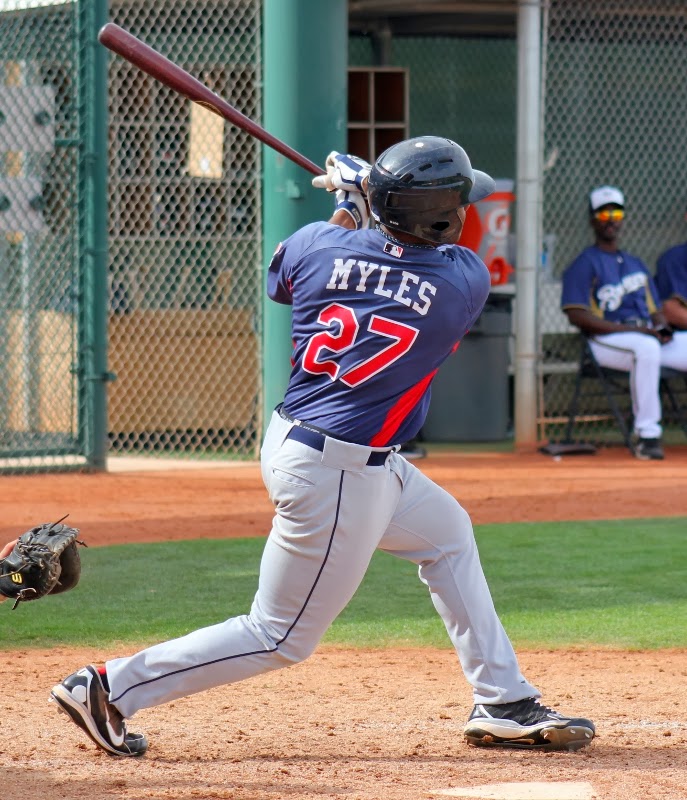
39. Bryson Myles, OF
DOB: 9/18/1989
Height/Weight: 5-11/230 lbs.
Bats/Throws: Right/Right
Acquired: 6th round pick in the 2011 MLB Draft
2013 Stats: .285/.357/.427 with 8 HR and 52 RBI in 92 games with high-A Carolina

Scouting Report: Steady, but unspectacular, Myles has posted an OPS between .734 and .795 in all three of his professional seasons. Last year was the first time he didn’t steal exactly 20 bases, swiping 15 in 22 attempts with the Mudcats. He walked 32 times and struck out 84 compared to 32 walks an 85 K in 2012. He hit exactly 20 2B and 2 3B in each of the past two seasons. He racked up 144 total bases in 2013 after tallying 140 in 2012. To say the least, Myles has been extremely consistent as a professional since the Indians selected him in the 6th round of the 2011 draft out of Stephen F. Austin State University. He missed the entire month of May with a shoulder injury, and started a little slowly in June when he returned to action. But from July 1 through the end of the season, Myles hit an impressive .317/.391/.452 with 4 HR in 58 contests. It was a strong showing to close out the season, and hopefully he can continue the momentum through to 2014.

At the plate, Myles has an average hit tool and below-average power from the right side. He was pretty pull-happy in 2011/12, and really worked hard on using all fields at the plate last year. When Myles is staying back on the ball and using all fields, he’s a much better hitter than when he gets out on his front foot and tries to power everything out to left field. He has a level, line-drive swing and does a nice job putting the bat on the ball. He’s an excellent bunter, and has no hesitation dropping one down the line for a base hit if he notices the 3B is playing back or napping.

Myles has above-average speed and is an excellent baserunner. He has 55 stolen bases in his career, and really runs well for his size. He doesn’t have the defensive chops to handle CF though, and his arm is probably a tick below average so he projects to LF long-term.

Myles has always been a little old for the levels he’s played, and will likely open 2014 with AA Akron as a 24-year old. He projects best at this point as a 4th outfielder, a guy who can play CF in a pinch, and provides speed and the ability to play small ball off the bench. He’s a hard worker and will get the most out of his tools and is a great guy to have in the organization.

Glass half-full: A 4th OF and pinch runner off the bench in the big leagues
Glass half-empty: Organizational depth

Photo Credit: Dave Monseur/Aeros
38. Jeff Johnson, RP
DOB: 2/9/1990
Height/Weight: 6-0/185 lbs.
Bats/Throws: Right/Right
Acquired: 10th round pick in the 2011 MLB Draft
2013 Stats: 0-1, 8 saves, 2.25 ERA with 50 K and 15 BB in 48 IP between high-A Carolina and AA Akron

Scouting Report: Johnson opened eyes around the organization in 2012, when he struck out 75 in 58 2/3 innings with 16 saves between Lake County and Carolina. He built on that 2012 with another solid season last year, serving as one of the Mudcats closers before getting the call up to Akron in July. Johnson’s numbers actually improved with the promotion to AA, as his K rate went up while his walk rate and WHIP dropped against Eastern League hitters. It was an encouraging season for the former 10th round pick out of Cal Poly San Luis Obispo, and the 23-year old looks more and more like a MLB bullpen piece every season.

Johnson is simple but effective, throwing just two pitches, a fastball and a splitter. The fastball sits in the 91-93 MPH range and can touch 95. He commands the pitch well and generally uses it to get ahead in the count before throwing his out pitch, a devastating splitter that dives down and out of the strike zone. The splitter is a plus pitch, coming in on hitters in the high-80s and looking very similar to his fastball. But the splitter tumbles down through the zone, and is difficult to hit, much less lift with any sort of power. He allowed just 2 HR all of last season, one each with the Aeros and the Mudcats. The splitter is a legitimate major league pitch and between it and the fastball, Johnson has a future as a power reliever.

Johnson wasn’t a highly regarded arm coming out of college and was selected in the 10th round partly for his signability. However, he’s a prime example of how it can be better to do one or two things exceedingly well than try to do too much and have their overall game suffer as a result. I’ll take a guy with two above-average to plus pitches over a guy with four or five below-average to average pitches any day. Johnson should be back in Akron to open the 2014 season, but could move quickly to Columbus based on his performance and how things shake in the AAA and major league bullpens this season.

Glass half-full: A power RP in the back end of a ML bullpen
Glass half-empty: The splitter stops splitting, and Johnson starts getting hit hard

Photo Credit: Al Ciammaichella
37. Shawn Morimando, SP

DOB: 11/20/1992
Height/Weight: 5-11/170 lbs.
Bats/Throws: Left/Left
Acquired: 19th round pick in the 2011 MLB Draft
2013 Stats: 8-13, 3.73 ERA with 102 K and 76 BB in 135 IP for high-A Carolina

Scouting Report: Morimando put together a solid season for the Carolina Mudcats as a 20-year old last year. His ERA actually rose by a half run after a disastrous final start on Sept. 1 when he gave up 7 ER in just 2 IP, so those numbers could’ve looked even better if he’d just not started that last game of the season for the Mudcats. Drafted out of Ocean Lakes High School in Virginia Beach, Morimando has risen steadily through the ranks despite less than dominant stuff. He threw just six innings in the complex leagues after he was drafted, but the Indians skipped him over short-season ball entirely and had him pitch all of 2012 with Lake County. Bumped up to the Carolina League last year, Morimando held his own against more experienced hitters, which is always an encouraging sign. To give you an idea of how young Morimando was for the level, just 32 of the 583 hitters he faced last season were younger than he was. Despite the young age, Morimando was still able to feature an 80-grade moustache last year.

Morimando is a command and control lefty who does a nice job inducing weak contact with his deceptive stuff. He throws three pitches, mixing in a curveball and changeup in addition to his fastball. His fastball sits between 86-89, but plays up a little due to some deception in his delivery. Coming from a ¾ arm slot, it has nice arm-side run and sink. His curveball is his best secondary pitch, a big, sweeping offering that comes in and runs across the strike zone. It’s an especially effective pitch against lefties, and helped Morimando hold same-siders to a .194/.318/.266 line in 2013 (.584 OPS). Development of the changeup will be key for Morimando, as it will give him a more effective pitch against right-handed batters. Righties put up a .732 OPS against Morimando last year, so those are some pretty distinct platoon splits.

Morimando is a good athlete, with a very clean, repeatable delivery. He’s an intelligent pitcher who will get the most out of his tools. His walk rate needs to come down, as a guy who pitches to contact the way Morimando does won’t be able to sustain a sub-4.00 ERA with a walk rate of 5.1/9 IP the way he did last season. If Morimando can command his fastball in the zone and pitch effectively to both sides of the plate, he’ll continue to find success as he climbs the organizational ladder. If he can refine his changeup and become more effective against righties in addition to lefties, then he’d be a legit SP prospect. As of now though, his RFP is a lefty out of the bullpen.

Glass half-full: A back-end starter
Glass half-empty: A left-handed reliever

Photo Credit: Al Ciammaichella
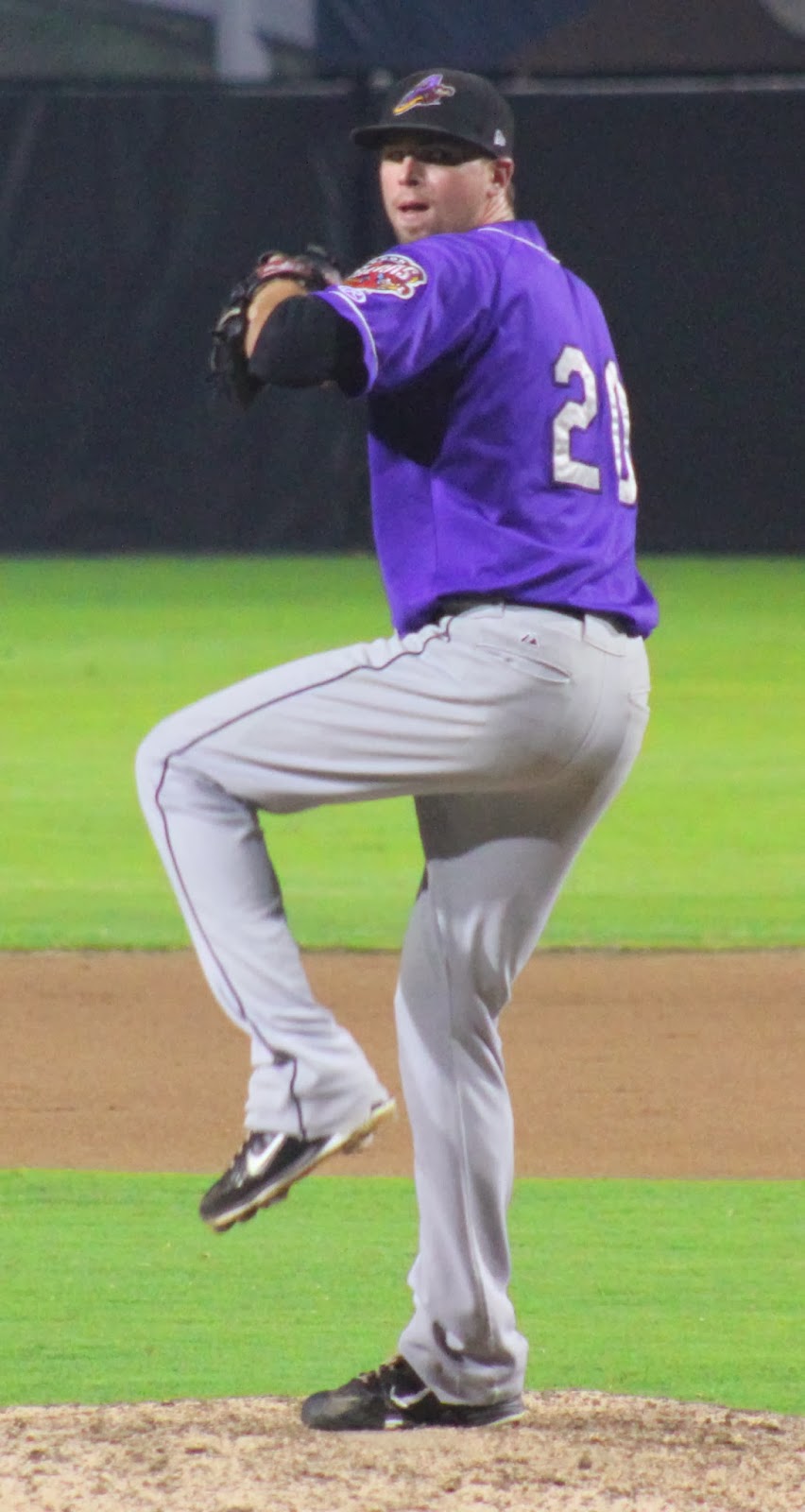
36. Trey Haley, RP
DOB: 6/21/1990
Height/Weight: 6-3/180 lbs.
Bats/Throws: Right/Right
Acquired: 2nd round pick in the 2008 MLB Draft
2013 Stats: 1-4, 7 saves with a 4.70 ERA, 46 K and 39 BB in 44 IP for AA Akron

Scouting Report: I’ve long been high on Haley, but 2013 was a big step backwards for the big right-hander out of Nacogdoches, TX. Haley posted a career-worst 8 BB/9 for the Aeros last year, struggling with his command for the entire season. When he was in the strike zone, Haley was pretty good; AA batters hit just .239 off of him with a .297 SLG. He gave up just nine XBH, all of them doubles. But based primarily on the sky-high walk rate, Haley allowed a .416 OBP against him, a rate far, far too high to be an effective pitcher out of the bullpen (or the rotation, for that matter). I watched Haley pitch in July of last year when the Aeros were visiting the Bowie Baysox. Aeros pitching coach Greg Hibbard was working with Haley on his glove placement through his delivery, trying to ensure that Haley kept his glove low and use it to pull himself through his delivery. Haley took Hibbard’s instruction well, and went out and got a save that night. He retired the side in order with one strikeout and was really in command of his stuff. Unfortunately for Haley, that was the exception rather than the rule in 2013.

Haley began his career as a starter and has a deeper repertoire of pitches than most relievers. His arsenal starts with one of the best fastballs in the organization, a four-seamer that sits between 94-96 and has touched triple digits in the past. He compliments the plus heat with a sinking two-seamer and both a curveball and slider. The curveball is his best secondary offering, a big, 11-5 breaker that can really freeze hitters because of the difference in velocity between that pitch and his fastball. It helps Haley change the eye level of hitters, and can help him get more swings at his high heat than he otherwise might. The slider is very tight with late life, and comes in looking a lot like his fastball. It’s inconsistent right now, but can be a weapon for Haley if he can get better command of the pitch. He even mixes in the occasional changeup, a pitch that can be particularly effective when he has a hitter sitting on his fastball.

When he’s in the strike zone, Haley can be a dominant relief pitcher. In July of last year, he put up a miniscule 0.68 ERA with 12 K and 6 BB in 13 1/3 IP. He converted all three of his save opportunities that month, showing a tantalizing glimpse of his raw potential. But he lost whatever momentum he was building in August, when he went 0-3 with a 5.68 ERA in 12 2/3 IP (10 BB, 15 K). Haley has the raw stuff of a backend reliever. But if he can’t command it within the strike zone, he’s never going to make it past AAA. Haley was added to the 40-man roster in 2013, but was outrighted off the 40-man to make room for closer John Axford this winter. No other clubs claimed Haley off waivers, so he remains in the organization and was assigned to AAA Columbus. If Haley can refine his delivery and harness his outstanding stuff, he could be an 8th or 9th inning guy in the major leagues. Time will tell if he can make the necessary mechanical adjustments though, as for now he looks less likely to make it to the majors than he did at this point in 2013.

Glass half-full: A dominant, back-end reliever

Glass half-empty: AAA version of bad Mitch Williams