Friday, March 07, 2014

Indians Prospect Countdown: #15-11

We're closing in on the top ten prospect in the Indians organization. Entering the top 15, we're looking at a power-hitting 1B who had a big winter campaign, a pitcher-turned-OF who made major strides in 2013, a college reliever who is going to get a chance to start as a professional, a power relief arm who could be in Cleveland this year and an infielder-turned-catcher who is among the hardest working players in all of minor league baseball.

Photo Credit: Al Ciammaichella
15. Jesus Aguilar, 1B
DOB: 6/30/1990
Height/Weight: 6-3/250 lbs.
Bats/Throws: Right/Right
Acquired: International free agent signing in 2007
2013 Stats: .275/.349/.427 with 16 HR and 105 RBI in 130 games with AA Akron

Scouting Report: After a decent season for AA Akron (.776 OPS), Aguilar went down to Venezuela for winter ball and set the league on fire, popping more HR (18) in 58 games for Caracas than he did in 130 games with Akron. He was 2nd in the entire Venezuelan League in HR, and his 1.000 OPS was good for 3rd. The Venezuelan Winter League is not particularly known for its pitching, but 18 HR is 18 HR.

Aguilar has as much raw power of anyone in the Indians minor league system. He puts on a show in batting practice, frequently launching balls out of the stadium. He can turn around anyone’s fastball, as evidenced by his performance against Orioles uber-prospect Dylan Bundy in 2012. Aguilar collected three hits against Bundy (including in the Futures Game and in the Eastern League playoffs), all off of his 97+ MPH fastball. As impressive as his power is though, it will likely never play up to its potential in game situations. Aguilar’s hit tool is merely average, and he’s still very susceptible to breaking balls down and out of the zone. He struck out 107 times in 2013, marking the 3rd consecutive season where he’s passed the century mark in K’s at the dish.

Defensively, Aguilar has worked very hard to get to fringe-average. He’s a big guy, and his mobility is always going to be below average. He has soft hands and does a nice job digging throws in the dirt at 1B. During Spring Training, he’s frequently out at the fields early with members of the Indians coaching staff working on his footwork and fielding at 1B. I saw Travis Fryman hit Aguilar about 200 grounders before one practice last year. It’s not that Aguilar is disinterested or lazy in the field, it’s just that the raw tools aren’t there for him to be an above-average 1B.

Entering his age-24 season, Aguilar is getting close to being a finished product. His pitch recognition/selection hasn’t evolved to where I’d hoped it would, and that will limit his power potential. He’s got a chance to be a 2nd-division 1B, but that’s pretty much his ceiling at this point. Aguilar is ready to be the everyday 1B for AAA Columbus, and will be on call should an injury create an opening at the big league level in 2014. He should post some pretty good power numbers in the friendly confines of Huntington Park in Columbus, but take those numbers with a grain of salt. He’s a very good mistake hitter, but is still overmatched when faced with high-quality breaking balls.

Glass half-full: A 2nd-division 1B with some pop
Glass half-empty: A DH/1B type with some pop off the bench

Photo Credit: Al Ciammaichella
14. Carlos Moncrief, OF
DOB: 11/3/1988
Height/Weight: 6-0/220lbs
Bats/Throws: Left/Right
Acquired: 14th round pick in the 2008 MLB draft
2013 Stats: .284/.354/.470 with 17 HR and 75 RBI in 129 games with AA Akron

Scouting Report: Moncrief got a little bit of a late start as an OF prospect. He was drafted as a starting pitcher, and spent two season on the mound before making the transition to the OF in 2010. He has an intriguing power/speed combination, as he’s averaged 17 HR and 16 SB over the past three seasons while working his way up the Indians minor league ladder. He’s made clear strides in his approach and pitch selection along the way, going from 158 K in 2011 to 126 K in 2012 to just 98 K last season with AA Akron. His batting average has increased every year as well, from .233 to .249 to .284, and as you’d expect, his OPS has been trending upwards as well (.768/.804/.824). He was probably the most improved player in the Indians organization last year, and is on his way towards a major league debut as early as 2014.

Moncrief has above-average pop from the left side of the plate, projecting to hit 20+ HR in a full season’s worth of AB. He has good bat speed, and really made significant strides in his pitch recognition/selection last year. Moncrief posted or equaled personal bests in AVG, OBP, SLG, HR, RBI, 3B, 2B, H, R and strikeouts last season. That’s an extremely encouraging developmental trend, as most young hitters start to struggle when they reach the more advance pitching of AA, but Moncrief broke out. Going into last year, I thought Moncrief’s hit tool would prevent his raw power from showing up in game situations. He proved me wrong in a big way, showing an ability to stay back on the baseball and use all fields in a way that I hadn’t seen from him before. It was an extremely impressive season, even if he was a little old for the level (owing to his two wasted seasons on the mound). He tallied 50 XBH in fewer than 500 AB last year, showcasing both his raw power and hitting ability.

As you’d expect from a converted pitcher, Moncrief has an absolute cannon in RF. He recorded 16 OF assists last year, as Eastern League coaches and baserunners tested him far more often than they should’ve. It’s a 7 arm that is both strong and accurate, and it’s a valuable weapon to have lurking in RF. With Moncrief in RF and Tyler Naquin in CF for Akron at the end of last season, the Aeros could boast two of the top arms in all of minor league baseball playing side by side. He’s also an above-average runner, tallying 15 or more SB in each of the last three seasons. The arm and mobility make him an ideal RF, and his bat should be able to play there.

After spending all of 2013 with AA Akron, Moncrief is now ready to contribute at the major league level as early as this season. The needs of the big club will dictate his timetable more than anything else at this point, but if Moncrief can continue his trend of improving his numbers across the board in every season, he’s going to force his way to Cleveland sooner or later. He jumped higher on this list than anyone else in the organization from 2013 to 2014 (33 last year, 14 this year) and has gone from intriguing skill set to a legitimate option at the major league level.

Glass half-full: A 20/20 RF at the major league level
Glass half-empty: A very useful 4th OF
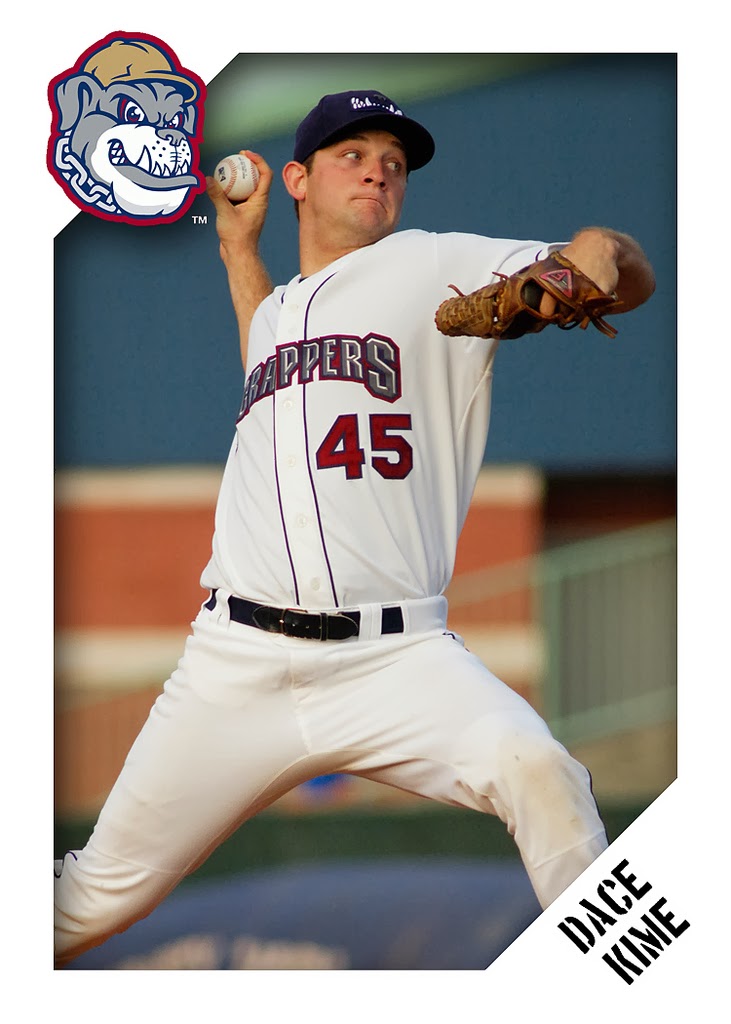
Photo Credit: Lianna Holub
13. Dace Kime, SP
DOB: 3/6/1992
Height/Weight: 6-4/200 lbs.
Bats/Throws: Right/Right
Acquired: 3rd round pick in the 2013 MLB draft
2013 Stats: 0-2, 2.92 ERA with 26 K and 16 BB in 24 2/3 IP for short-season Mahoning Valley

Scouting Report: Kime was born and raised in Defiance, Ohio, and attended the University of Louisville where he pitched primarily out of the bullpen. The Indians believe he can be a starter in the professional ranks, and he pitched exclusively in the rotation with the Mahoning Valley Scrappers in 2013. He put up solid numbers in his 9 starts in the NYPL, striking out more than a batter per inning and putting up a sub-3.00 ERA. He did walk 16, showing inconsistent command and struggling a little to repeat his delivery in that small sample.

Kime’s fastball sits in the low-90’s and can touch 95. He delivers it from a high ¾ arm slot that gives it some arm-side run and sink. Fastball location is going to be extremely important for Kime. If he can spot his fastball and keep it down in the zone, he’ll be successful. When he struggled last year, it was because his fastball location was inconsistent. He has two secondary offerings, a curveball and a changeup. The curve flashes plus, a big, bending pitch with strong 11-5 action. It should be at least an above-average pitch at the major league level. The changeup is intriguing, as it can be a very good pitch but sometimes stays flat and hittable. Refining and improving the changeup will be big for Kime, but scouts feel like it’s a pitch that he’ll have in his arsenal moving forward.

Kime doesn’t profile as a top of the rotation arm, but that doesn’t mean he won’t have value moving forward. He has the potential for three above-average pitches, and while that doesn’t make him the sexiest prospect in the system, it gives him an awfully good chance of a future in a major league rotation. He projects as a good #4 or a low #3 right now, but if any of those pitches tick upwards to plus, he can easily be a #3 in a good rotation. He’s a big, strong kid with a starter’s body and arsenal who should open up the 2013 season in the Carolina Mudcats rotation.

Glass half-full: A #3 in a playoff-level rotation
Glass half-empty: A #4 in an average rotation

Photo Credit: Al Ciammaichella
12. Austin Adams, RP
DOB: 8/19/1986
Height/Weight: 5-11/190 lbs.
Bats/Throws: Right/Right
Acquired: 5th round pick in the 2009 MLB Draft
2013 Stats: 3-2, 4 saves, 2.62 ERA with 76 K and 29 BB in 55 IP for AA Akron

Scouting Report: Austin Adams was a top-5 prospect in the organization heading into the 2012 season. He was a starting pitcher at the time, but injured his shoulder and went down with season-ending surgery to correct the issue. He didn’t appear in a single game in 2012, and when he returned in the spring of 2013, it was out of the bullpen. Adams pitched exclusively out of the ‘pen last year, recording 4 saves and posting a 3-2 record. It was a successful bounceback season for Adams, as shoulder injuries are more difficult to recover from than elbow injuries, and it was unclear as to whether Adams would have similar stuff compared to his pre-injury repertoire.

Prior to the shoulder troubles, Adams was able to touch triple-digits with his fastball. He wasn’t able to get it up quite that high in 2013, but was still able to touch 98 several times when I saw him last August. He compliments the plus fastball with a very good slider that flashes plus, as well as a curveball and a changeup. The slider has tight, sharp break with excellent tilt. The curveball is a weapon that Adams can use to change the eye level on hitters, and the change is a nice 4th offering to keep hitters honest. The tendency for hitters is to sit on Adams heat, and the change can really make them look silly when he throws it in a 2-0, 3-1 or other count when hitters are guessing fastball. Adams pitches to both sides of the plate, and loves to come inside on batters to make them uncomfortable in the box.

Adams has closer’s stuff, and now that he’s been fully transitioned from a starter to a reliever, he should move quickly through the system. A former shortstop at Faulkner College, Adams is an excellent athlete who does a nice job repeating his delivery. When he’s throwing strikes, Adams is successful. He posted the highest BB/9IP ratio of his career last year (4.7), but that can be expected from a guy coming off of major shoulder surgery and a full year layoff from pitching. There were only two outings last year where he allowed an earned run without walking at least one batter. His ability to miss bats (12.4 K/9IP last year) will help him overcome a higher than normal walk rate regardless, but I think that walk rate is going to come down in 2014. He’s close to being a finished product, and could easily pitch in Cleveland this season based on the needs of the big league club. Relievers who throw 97+ generally find a way to contribute to a major league ballclub, and I don’t expect Adams to be an exception to that rule. He’s the top true reliever in Indians minor league system right now, and a potential closer down the road if the need arises at the corner of Carnegie and Ontario.

Glass half-full: A 9th inning arm in a major league bullpen
Glass half-empty: A 7th inning arm in a major league bullpen


Photo Credit: Al Ciammaichella
11. Tony Wolters, C
DOB: 6/9/1992
Height/Weight: 5-10/177 lbs.
Bats/Throws: Left/Right
Acquired: 3rd round pick in the 2010 MLB draft
2013 Stats: .277/.369/.353 with 3 HR and 33 RBI in 80 games for high-A Carolina

Scouting Report: Last year at this time, Wolters was one of several impressive middle infield prospects coming through the Indians system. He was coming off of a solid season with high-A Carolina, and figured to start the 2013 season as the everyday 2B in Akron. But at the end of March, as camp was breaking, the Indians made a surprise announcement; Wolters would be switching positions. Moving forward, Tony Wolters would be a catcher. The move took everyone off-guard, as Wolters had caught only sporadically in high school and was seen as a top-10 prospect in the organization playing in the middle infield. Moves like that are generally made out of desperation, and the Indians were hardly desperate with Wolters in 2013. In this case, the move was made because the Indians genuinely think that Wolters can be an above-average backstop, and his offensive profile plays even better behind the plate than it does at 2B or SS. Known throughout his career as an extremely hard worker, Wolters threw himself into learning the position in extended spring training before joining the Carolina Mudcats for a 2nd season. His offensive numbers in 2013 were very similar to 2012’s, but considering he was learning not only a new position but the most difficult position on the diamond, I’d consider it a successful season.

At the plate, Wolters is a patient hitter with an advanced approach from the left side. He has a smooth, level swing that offers excellent plate coverage and sprays line drives all over the field. Wolters took a huge step forward in his approach last season, walking 41 times and striking out 58 in 340 plate appearances after walking just 36 times and recording 104 strikeouts in 537 PA’s in 2012. That’s a 10% walk rate, up from 6% the year before. Wolters did see his power numbers dip slightly, slugging just .353, but I expect that to be a one-year aberration rather than a trend. It’s an enticing profile as a catcher, and if Wolters can provide even adequate defense at the position, he has a chance to catch in the big leagues.

Defensively, Wolters is still a work in progress. But he’s further along after one season at the position that I thought possible. Lucky for Wolters (and the Indians), the Carolina Mudcats manager last year was David Wallace. Wallace was an outstanding defensive catcher in his playing days, and is the ideal guy to help mold a young backstop into a solid receiver and defender. Wolters made some dramatic strides in his defensive game last year, going from a 2B who was playing catcher to an actual catcher by the end of the season. His soft hands help his receiving, and his athleticism really has him moving well behind the plate. He allowed just 6 passed balls in 58 games behind the plate with Carolina, an amazing number for a new catcher on the receiving end of high-A pitching. Teams clearly tried to run on Wolters, as he threw out 25 of 90 attempted basestealers. That 28% ratio is respectable, and it will likely improve as Wolters improves his footwork and cleans up his throwing actions behind the plate. He has all the tools to be an above-average defensive catcher, he just needs time and reps to put it all together on the field.

Wolters is one of the hardest working players in the Indians organization, which is one reason they thought the move to catcher would stick. He plays with a high baseball IQ, and will always get the most out of his tools. He’s a lot of fun to watch play, and is one of my favorite players in the system. None of his tools grade out as plus, but none are significantly below-average, either. Wolters will likely move up to AA Akron along with manager David Wallace, so the two of them will be able to work on developing Wolters as a catcher for at least one more season. He’s got a difficult road to the majors as a converted catcher, but if anyone can make it happen, Tony Wolters can.

Glass half-full: An offense-oriented 2nd division starting catcher
Glass half-empty: The transition behind the plate doesn’t take and Wolters becomes a super-utility player


​

Thursday, March 06, 2014

Indians Prospect Countdown: #20-16

We're halfway home in our little countdown, as we've reached the top-20 prospects in the Indians organization. We're going to look at another bonus-baby pitcher who was drafted straight out of high school, an outfielder who is short on experience but long on upside, a southpaw who has a change to make an impact in the rotation this year, a potential 2014 bullpen piece and a catcher who spurned his home state of Michigan to commit to Ohio State before agreeing to start his professional career with the Indians. 

Photo Credit: Al Ciammaichella
20. Mitch Brown, SP
DOB: 4/13/1994
Height/Weight: 6-1/195 lbs.
Bats/Throws: Right/Right
Acquired: 2nd round pick in the 2012 MLB Draft
2013 Stats: 3-5, 6.78 ERA with 66 K and 40 BB in 67 2/3 IP between low-A Lake County and the Rookie League Arizona Indians

Scouting Report: Brown is a bit of a rarity in baseball; a high draft pick from a Northern high school. Selected in the 2nd round (79th overall) out of Rochester, Minnesota in 2012, Brown was given an over-slot $800,000 signing bonus to forgo his commitment to the University of San Diego. Brown struggled in his first go-around in full-season ball last year. He opened the season in the rotation for low-A Lake County, but was sent back to extended spring training after going 1-1 with an 11.49 ERA in 5 starts with the Captains. Brown struck out an impressive 18 hitters in 15 2/3 Midwest League innings, but also struggled with his control, walking 11 and hitting 4 batters. Brown got back into the rotation with the Arizona Indians but again struggled, going 2-4 with a 5.37 ERA in 52 IP. He again struggled with his control, walking 29 in the complex leagues. It was a step back for a pitcher that many thought was coming to the professional ranks more advanced than most high school arms, but Brown’s underlying talent hasn’t gone anywhere.

Brown features a four-pitch mix, including a 4-seam fastball, a cutter, curveball and changeup. The 4-seamer sits comfortably between 92-94 MPH, and can touch 96. It has a little natural sink to it, and when he’s spotting it well it is a very effective pitch. His best secondary offering is his cutter, a pitch that really bears in on the hands of lefthanded hitters. It has the potential to be a plus pitch at the major league level, and is really a key in Brown’s development. His curveball is inconsistent but flashes plus, it just needs some more time and repetitions to develop. His changeup lags behind his other three offerings, but will at least be a show pitch for Brown to keep hitters guessing. It’s a deep arsenal that ensures Brown will remain in the rotation long-term, provided he can command those four offerings of course.

Brown is a strong kid and a good athlete who has the strength and stamina to be an innings-eater in a major league rotation. He has outstanding makeup, as scouts, coaches and teammates alike rave about his work ethic and leadership qualities. He had a rough season in 2013, and it will be interesting to see how he bounces back this season. He has the talent and the fortitude to bounce back and have a big season and put himself right back in the mix as one of the Indians top pitching prospects, and could easily be in the top 10 of this list come next offseason. He still has the talent that made him a top-50 overall prospect in the 2012 draft, and if all breaks right he could still rise as high as a #2 in a major league rotation.

Glass half-full: A #2 starter in The Show
Glass half-empty: A back-end starter in the majors

Photo Credit: Lianna Holub
19. Anthony Santander, OF
DOB: 10/19/1994
Height/Weight: 6-2/190 lbs.
Bats/Throws: Switch/Right
Acquired: International free agent signed in 2011
2013 Stats: .242/.303/.370 with 5 HR and 31 RBI in 61 games for low-A Lake County

Scouting Report: Santander was one of the Indians big $$ signings in 2011, signing out of Venezuela for a $385,000 bonus. He made his stateside debut in 2012 with the Rookie League Arizona Indians, posting a .874 OPS in 43 games in the desert. The Indians got aggressive with Santander, challenging the 18-year old with an assignment to the Midwest League last year. He struggled a little at the dish, putting up just a .672 OPS and striking out 43 times against just 13 walks. But he was able to show flashes of his potential, hitting 5 HR and 13 doubles in 219 AB in what is a very pitcher-friendly league. It wasn’t a dominant season by any means, but for an 18-year old in his first taste of full-season ball, it wasn’t a disaster either.

Santander started switch hitting just a few years ago, but he’s already showing great potential from both sides of the dish. He has smooth, level swing from both sides and projects to have plus power down the road. He’s got quite a bit of room to grow into his 6’2” frame, and once he fills out his power will develop. He has a bit of natural loft in his swing, and puts some backspin on the ball to help it carry.

Defensively, Santander projects best to LF at the next level. He has decent speed, but a below-average arm and doesn’t have the defensive chops for CF. The speed will likely decrease as he fills out, so he’s a natural fit in LF. He did play all 61 games for Lake County in RF last year, so it’s clear that the Indians are trying to keep him in RF until he proves that he cannot play there. I still see him as a LF long-term, but his overall profile would tick upwards if he is able to stay in RF. Regardless of which corner OF spot he ends up in, his hitting ability and power from both sides of the plate provide a tantalizing package for an organization that has struggled to develop an impact bat in the OF. He’s probably going to repeat the low-A Midwest League to start out 2014, but could be in line for a promotion to Carolina if he can get off to a hot start with the Captains.

Glass half-full: A switch-hitting version of Michael Brantley with more pop
Glass half-empty: We’ve got a long ways to go before we get there

Photo Credit: Al Ciammaichella
18. T.J. House, SP
DOB: 9/29/1989
Height/Weight: 6-1/205 lbs.
Bats/Throws: Right/Left
Acquired: 16th round pick in the 2008 MLB draft
2013 Stats: 9-11 with a 4.17 ERA with 137 K and 57 BB in 164 IP between AA Akron and AAA Columbus

Scouting Report: House began the 2013 season with AA Akron, but made just 4 starts in an Aeros uniform before getting promoted to AAA Columbus. He went 2-1 with the Aeros, striking out 27 and walking just 3 in 22 1/3 IP. His K rate dropped and walk rate climbed during his first stint in AAA, but posted solid numbers, especially considering that he threw most of his innings in the friendly confines of Huntington Park. He improved as the season went on, and was at his best in the months of July and August when he went a combined 6-2 with an ERA below 3, and  55 K’s to just 21 BB. He led the Clippers in both IP and strikeouts, proving resilient and effective after his rough May and June. As is typical, he was more effective against same-siders than righties. Righthanded batters hit .301 off of House, while lefties hit just .254. He’s a good athlete, repeating his delivery consistently. He’s got a high baseball IQ, and will always get the most out of his stuff on the mound.

House sets everything up with his fastball, an above-average offering that sits consistently between 91-94 MPH. It touches as high as 96, and has nice arm-side run. House works from a high ¾ arm-slot after experimenting with a move over the top delivery after he was drafted in 2011. His best secondary offering is his slider, an above-average pitch that has nice late life. It’s especially tough on lefties, and is a real swing and miss offering for him. He rounds out his repertoire with a changeup that is still a work in progress. If he can refine the changeup to the point where it is a legitimate weapon against righthanded hitters, House’s future in the rotation would be a lot clearer.

Last offseason, the Indians had the chance to roster either House or fellow southpaw T.J. McFarland. They chose the younger House, and McFarland was selected in the Rule 5 draft by the Baltimore Orioles. McFarland stuck with the Orioles all season, and will be a member of their bullpen again in 2013. The Indians believe that House can start, even if it’s filling out the back end of a major league rotation. He’ll be 24 years old for the 2014 season, and while he’s almost certain to start out in the rotation for AAA Columbus, he’ll be one of the first options considered for a call-up should injury or ineffectiveness befall one or more members of the Indians starting 5.

Glass half-full: A #3/4 starter in a major league rotation
Glass half-empty: A #4/5 starter in a major league rotation

Photo Credit: Al Ciammaichella
17. C.C. Lee, RP
DOB: 10/21/1986
Height/Weight: 5-11/190 lbs.
Bats/Throws: Right/Right
Acquired: International free agent signed in 2008
2013 Stats: 0-0, 4.15 ERA with 4 K and 3 BB in 4 1/3 IP for Cleveland; 1-0, 2.48 ERA with 37 K and 10 BB in 29 IP between Lake County, Akron and Columbus.

Scouting Report: Lee would’ve likely been a regular fixture in the Indians bullpen last season, but he suffered an elbow injury and was able to throw just 7 innings in 2012. Still, even after the lost season, Lee was able to climb the organizational ladder to make his major league debut last year, throwing 4 1/3 innings for the Indians out of the bullpen. He’s posted some eye-popping strikeout numbers throughout his career, racking up 323 K in 263 1/3 minor league innings, good for an even 11 strikeouts per 9 IP.

Lee attacks hitters from a variety of arm angles, working from ¾ to sidearm and everywhere in between. His fastball sits between 92-95 MPH and can touch 97. It’s impressive velocity for a guy who stands less than 6’ tall, and because of the arm angles that Lee uses the pitch has a ton of movement. His 2-seamer has a lot of arm-side run and sink, bearing in on the hands of righthanded hitters. He compliments the pitch with a plus slider, a pitch with outstanding life and tilt. The pitch is murder on righthanded hitters, and I’ve seen some very good hitters look foolish when facing the pitch. He also has a forkball that acts as his change of pace pitch. It can really dive down and away from righties, and while it’s an effective 3rd pitch it’s not the swing and miss offering that his slider has been.

Lee pretty much is what he is at this point, and has a very good chance to break camp in the Indians bullpen. He could serve in the Joe Smith role in 2014, an effective weapon to neutralize an opponent’s top righthanded hitter(s) late in the game. He’s probably never going to be a closer in the major leagues because he’s not as effective against lefties as he is against righties, but he should still be a very effective back-end arm in the new and improved Bullpen Mafia.

Glass half-full: A late-inning arm, effective against hitters on both sides of the plate
Glass half-empty: A late-inning arm, used primarily against righties

Photo Credit: Al Ciammaichella
16. Eric Haase, C
DOB: 12/18/1992
Height/Weight: 5-10/180 lbs.
Bats/Throws: Right/Right
Acquired: 7th round pick in the 2011 MLB draft
2013 Stats: .250/.322/.439 with 14 HR and 47 RBI in 104 games for low-A Lake County

Scouting Report: Selected in the 7th round of the 2011 draft, the man who was named Michigan’s “Mr. Baseball” as a high school senior was wooed away from his commitment to The Ohio State University with an over-slot $580,000 signing bonus. He’s an example of a guy who’s projection far outpaces his actual production at this point in his career, but I’m a big believer in the tools and I think he’ll play up to this ranking.

Haase has above-average tools across the board. He has plus raw power and an above-average hit tool from the right side of the plate. His opposite-field power in particular is impressive for a player with his experience, something that Haase says came from pitchers trying to work around him when he was in high school. Haase had to learn to hit the ball where it was pitched, because it was a rare occurrence for him to see something on the inner half as a prep player in Michigan. He has quick, strong hands and can let the ball travel deep into the hitting zone before deciding whether or not to swing, and does a nice job staying inside the baseball and using all fields. He struggled a little last season in the difficult hitter’s environment of the Midwest League, striking out 117 times against just 40 walks. It was his first taste of full-season professional baseball, and his “struggles” are nothing to be too concerned about. For a 20-year old from a Northern High School, playing in the Midwest League, he held his own just fine.

Defensively, Haase has all the tools to be a 6 defender at the major league level. He moves well behind the plate, has quick feet and strong fundamentals. He’s worked on his throwing mechanics since turning pro, and his quick actions allow his plus arm to play to a level where it is a weapon in controlling the opposing teams’ running game. He threw out 49 of 137 would-be baserunners last year, good for a 36% caught-stealing percentage. He handles pitchers well and is a good receiver who uses his soft hands to frame pitches on the outer edges of the strike zone.

Haase has everything you look for in a catcher, as his baseball tools and intelligence all rate above-average. He’s an excellent athlete and a natural leader who is playing above his experience level right now. When he has a chance for his tools to catch up to the steep learning curve he’s on, look out. I’m a little higher on Haase than most, owing to both my love of catchers and just how impressed I was watching Haase play in Goodyear the past two seasons. He’s got a ways to go before he’s ready to contribute at the major league level, but I see an above-average catcher on both sides of the baseball once he gets there. Haase will likely move up to high-A Carolina in 2014, and will again be challenged by a notoriously difficult hitter’s league. So don’t worry if the stats don’t pop off the page; the tools are there, they just need a little seasoning.

Glass half-full: An all-star catcher

Glass half-empty: A solid backup catcher

Wednesday, March 05, 2014

Indians Prospect Countdown: #25-21

We're looking at five really interesting players on the countdown today. Starting off with one of the Indians better SP prospects who put together a solid season at low-A last year, and rolling right into a catcher who opened some eyes in Akron. Rounding out this installment is a toolsy OF who can't stay healthy, a fast-moving lefty reliever who dominated in 2014 and a young, talented right-handed pitcher who should be making his full-season debut in 2014. 

Photo Credit: Lianna Holub
25. Dylan Baker, SP
DOB: 4/6/1992
Height/Weight: 6-2/215 lbs.
Bats/Throws: Right/Right
Acquired: 5th round pick in the 2012 MLB Draft
2013 Stats: 7-6, 3.63 ERA with 117 K and 62 BB in 143 2/3 IP with low-A Lake County

Scouting Report: Baker attended high school in the baseball hotbed of Juneau, Alaska before attending JuCo in Nevada. He was a dominant arm in college, going 13-0 with a 1.91 ERA for Western Nevada and winning his conference’s play of the year award. He signed in time to make his debut with the Rookie League AZL Indians in 2012 and impressed in a short stint, striking out 30 in 24 IP. He spent all of 2013 with the Lake County Captains, leading the team in both IP and strikeouts as a 21-year old.

Baker’s fastball sits comfortably in the 91-94 MPH range, and has touched 97 in the past. He delivers the pitch from a very high, over-the-top arm angle that helps offer a difficult plane for hitters and helps the pitch have nice sinking action. His featured secondary offering is a 12-6 curveball that really falls off the table as it crosses home plate. He also throws a changeup that lags behind the curveball in effectiveness, but has shown some quality with late fade down and away from righties.

Baker does a nice job locating his pitches down in the zone, using his sinking fastball to pitch to contact and let his fielders do a lot of the work for him. He posted a 1.37 GO/AO ratio last year, and allowed just 3 home runs in almost 150 innings of work. He lacks a true bat-missing offering, and that could prove troublesome as he works his way up the organizational ladder. It’s tough for guys who strike out fewer than 8 hitters per 9 IP in low-A to find sustained success at the higher levels, so I’m really interested to see how Baker handles hitters at high-A Carolina this year. He’ll turn 22 on April 6, so he needs to advance at least a level per season to be on a major league trajectory. It’s still possible that he becomes a 2-pitch power reliever, in which case he’d have an opportunity to move through the org much more quickly. The refinement of the changeup is key for Baker, and if it can develop into a pitch that is effective against hitters from both sides of the plate, it’ll go a long ways towards keeping Baker in the rotation and moving up the ladder towards Cleveland.

Glass half-full: A solid, back of the rotation innings-eater
Glass half-empty: A 2-pitch power reliever

Photo Credit: Al Ciammaichella
24. Jake Lowery, C
DOB: 7/21/1990
Height/Weight: 6-0/195 lbs.
Bats/Throws: Left/Right
Acquired: 4th round pick in the 2011 MLB Draft
2013 Stats: .264/.359/.437 with 7 HR and 33 RBI in 82 games between high-A Carolina and AA Akron

Scouting Report: Lowery was the Indians 4th round selection in the 2011 draft out of James Madison University in Virginia, the same year in which he won the Johnny Bench Award as the nation’s top collegiate catcher. In a time where HR were on the downswing in college baseball, Lowery popped 24 HR his senior year, and the coaches in the Colonial League voted him as the top defensive catcher in the conference. After playing 69 games with the Mahoning Valley Scrappers in 2011, the Indians aggressively pushed the 21-year old Lowery to high-A Carolina in 2012. He struggled at the plate in 59 games with the Mudcats, posting a .640 OPS before being sent down to Lake County to finish out the season. He was much better in low-A, putting up a .862 OPS with 7 HR in 39 games for the Captains. Lowery was back in Carolina to start the 2013 season, but was quickly pushed up to AA Akron where he put together a solid season at the plate. In 70 games (236 AB) with the Aeros, Lowery hit .275/.363/.449 with 6 HR and 28 RBI. It was a solid showing against advanced pitching for the 22-year old, one that vaulted him up to the top-25 on this list after appearing in the 40’s last year.

Offensively, Lowery projects to have 5+ power and 4+ hitting ability from the left side. For a catcher, that’s a pretty good hitter. He has a .769 career minor league OPS in 249 games, but I’m focusing more on his performance in AA last year as a 22-year old. He has a smooth, quick load at the beginning of his swing and shows good balance throughout. He hits both lefties and righties well, showing slightly better splits against RHP as you’d expect. He has a solid approach, walking 33 times en route to a .363 OBP for Akron last year. He doesn’t typically chase pitches outside of the zone early in the count, helping to set himself up for quality at bats. He only managed 6 HR in 70 AA contests, but did hit 21 doubles, some of which will turn into HR’s as Lowery continues to add strength and size to his athletic frame.

Defensively, Lowery has a little more work to do. He moves well behind the plate and is a good receiver. Pitchers in the organization like throwing to Lowery, and he does a nice job handling a staff. He has plus arm strength, and can throw a strike to 2B without ever leaving his knees. But his arm actions are still a little slow, and the Indians would like to see him clean those up in an effort to help control the opposing running game. Lowery threw out 24 of 86 would-be basestealers last season in Akron, good for a 28% CS rate. That’s right in line with his career 30% CS, a number that would ideally be more in the 35-40% range with his arm strength.

Lowery will likely be back in AA as the RubberDucks (that’s going to take some getting used to) catcher in 2014, and if he can match or improve on last year’s AA offensive numbers, his prospect standing could take another leap forwards. Power-hitting catchers are in precious short supply, especially those that hit from the left side of the plate. Lowery looks like he should at least have a major league career as an offense-oriented backup, and is just a couple of years away from realizing that potential. The Indians are pretty well set at the catcher position right now between Yan Gomes and Carlos Santana, but if Lowery’s bat can continue to progress, it could push him past defensive whiz Roberto Perez on the organizational pecking order.

Glass half-full: A 2nd division starter with some pop
Glass half-empty: An offense-oriented backup catcher

Photo Credit: Al Ciammaichella
23. LeVon Washington, OF
DOB: 7/26/1991
Height/Weight: 5-11/170 lbs.
Bats/Throws: Left/Right
Acquired: 2nd round pick in the 2010 MLB Draft
2013 Stats: .348/.444/.552 with 5 HR and 32 RBI in 61 games between the Rookie League Arizona Indians and low-A Lake County

Scouting Report: Washington is an extremely difficult guy to rank. Talent-wise, he’s a top-10 guy in the organization. He’s a plus athlete, a good hitter and speedy runner on the basepaths and in the OF. But he’s been unable to stay on the field since being drafted, playing a total of just 156 games in the 3+ seasons since he was drafted in 2010. He was plagued by shoulder issues coming out of Chipola College, but had surgery to get past that and reported to Goodyear healthy in 2011. Knee issues disrupted his 2011, limiting him to just 79 games with low-A Lake County. He had a big spring in 2012 and looked ready to breakout, but tore a tendon in his hip, requiring surgery and missing a huge chunk of action. In 2013, nagging hamstring issues limited him to just 61 games (51 with Lake County). When he was on the field, Washington was outstanding in 2013. He posted a .997 OPS, hit 5 HR and stole 16 bases while only being caught 4 times between Lake County and Arizona. Talent isn’t the problem with Washington; health is.

At the plate, Washington has an above-average hit tool and below-average power. He’s skinny but wiry, with gap power at best. He’s more of a slap hitter who likes to put the ball in play and use his legs to make things happen. He can turn on an inside fastball though, and has enough strength and bat speed to project at least gap power. He has excellent plate coverage and does a good job hitting the ball where it is pitched, using all fields and not trying to do too much. He has a solid approach, walking 37 times last season against just 54 strikeouts. Washington’s peak could feature something like a .310/.390/.430 triple slash line; he’s that good.

In the field, Washington should be able to stick in CF. He has plus speed and covers a lot of ground on the outfield, getting good reads on the ball. His arm is slightly below average, but it has come a long way since 2010 following the surgery on the torn labrum in his shoulder. At one point, it was thought that the arm would limit Washington to LF or even prompt a move to 2B, but his strength has returned to at least Sizemorian levels in CF.

For all of #WASHTIME’s (former) bluster on twitter, I’ve always found Washington to be a humble, hardworking player. He admitted to me that he began his career taking professional baseball a little too lightly, figuring his talent enough would be sufficient to propel him to the major leagues in short order. That proved to not be the case, as Washington struggled with both injuries and ineffectiveness during his rookie campaign of 2011. When I saw him during spring training in 2012, he was a completely different player. He was spraying line drives all over the ballpark, impacting the game with his speed on the bases, and making outstanding hustle plays in the field. There is no denying Washington’s raw talent. He’s one of the most athletic, dynamic players in the entire system. But health can also be a skill, and that’s one that Washington has yet to master. If he can just stay on the field for an entire season, Washington could be right back in the top-10 on this list next season. But until he can stay healthy enough to allow his prodigious tools to play, he’s going to keep sliding down in the prospect rankings. Washington should finally make it to Carolina to stay this season, and if he can be healthy and effective in the early going, a promotion to Akron in short order would be appropriate for the 22-year old. He still has time to make an impact for the Indians, but can’t do so from the training table.

Glass half-full: The good version of Carl Crawford
Glass half-empty: The bad version of Grady Sizemore

Photo Credit: Lianna Holub
22. Kyle Crockett, RP
DOB: 12/15/1991
Height/Weight: 6-2/170 lbs.
Bats/Throws: Left/Left
Acquired: 4th round pick in the 2013 MLB Draft
2013 Stats: 1-0, 0.36 ERA with 32 K and 5 BB in 24 2/3 IP between short season Mahoning Valley, low-A Lake County and AA Akron.

Scouting Report: Crockett was selected in the 4th round of last year’s draft out of the University of Virginia and signed for a $463,000 bonus, which was pretty much right on the $463,600 slot. Crockett was the closer for UVA last year, and posted some pretty impressive numbers in college. He struck out 71 and walked just 7 in 58 1/3 IP in Charlottesville, showcasing some impressive command and control while pitching in the ACC. After signing, Crockett went on a whirlwind tour of the Indians minor league organization, pitching for the Scrappers, Captains and Aeros, finding success at all three levels. His age, experience and polish make him a guy who will spend a lot less time in the minors than most prospects, and he could easily be the 2013 draft’s version of Cody Allen for the Indians.

Despite the high strikeout numbers, Crockett doesn’t have overpowering stuff. His fastball sits in the low-90’s, and comes from a low ¾ angle that makes it tough for hitters to pick up the baseball. The velocity plays up due to the deception in his delivery, and the arm-side run on his fastball makes it play up a full grade. He compliments the fastball with a big, sweeping slider that is murder on lefties and makes him, at worst, a future LOOGY in the majors. It’s just a two-pitch arsenal, which will keep Crockett in the bullpen, but it’s been both simple and extremely effective for him in his career thus far.

Crockett gave up just one earned run as a professional last season, a solo HR while he was pitching for the Lake County Captains. His overall numbers were eye-popping; 11.7 K/9, just 1.8 BB/9 and a 0.851 WHIP to go along with the miniscule 0.36 ERA. As good as he is against lefties, Crockett didn’t give anything up to right-handed hitters last year either. He’s likely to begin the 2014 season back with AA Akron, but has the talent and polish to make it to the major leagues as early as this year. Need at the MLB level will do more to dictate Crockett’s timeline than his own performance will, but if the Indians need a lefty out of the bullpen down the stretch this year, they won’t have to make a deadline deal to acquire him as they did with Marc Rzepczynski in 2013. Crockett will be ready and waiting to contribute if the need arises.

Glass half-full: An effective arm in the back end of a MLB bullpen
Glass half-empty: An effective LOOGY in the back end of a MLB bullpen

Photo Credit: Al Ciammaichella
21. Kieran Lovegrove, SP
DOB: 7/28/1994
Height/Weight: 6-4/185 lbs
Bats/Throws: Right/Right
Acquired: 3rd round pick in the 2012 MLB Draft
2013 Stats: 1-7 with a 5.25 ERA with 51 K and 31 BB in 58 1/3 IP for the Rookie League Arizona Indians

Scouting Report: Kieran Lovegrove is easily the best Indians prospect who was born in South Africa. He grew up playing cricket, not baseball, but hasn’t looked back since he became a pitcher rather than a bowler. He was the Indians 3rd round selection in the 2012 draft, and has appeared exclusively in the rookie level Arizona League the past two seasons. He’s a big (6’4”), projectable arm that should be able to stick in the rotation long-term who should be making his full-season debut in 2014.

Lovegrove was sitting between 89-93 with his fastball velocity coming out of high school, but picked up several MPH last offseason. When I saw him in Goodyear last spring, he was sitting between 92-95, touching 97 several times in a 3-inning stint. He worked a lot on using his lover half better, and getting his legs more involved in The fastball has a chance to be a legit plus pitch once he refines his command and control. His 2-seamer has some arm-side run and sink, and it’s most effective when he works down in the zone to induce weak contact. He compliments the fastball with a slider and changeup. The slider flashes plus, and has sharp, late life when he’s throwing it well. Developing the changeup was a major goal for Lovegrove in 2013, and he’s gotten it to a point where he’s comfortable throwing the pitch in almost any count. The refinement of his secondary stuff is key for Lovegrove, and if he can turn the slider into a legit, bat-missing strikeout pitch, it’d be a huge step in his development.

When he was still in high school, Lovegrove co-founded a charity, the Going to Bat Foundation. Through the foundation, Lovegrove helps provide balls, bats and other baseball equipment to disadvantaged youths throughout America and Africa. That’s an impressive thing for a high school kid to do, and shows advanced maturity for a teenager. He's also pitched internationally for Team South Africa in the preliminary rounds of the World Baseball Classic, getting a change to play with and against guys much older and more experienced than himself. Lovegrove has great makeup, and his attitude on and off the baseball field will help him maximize his tools and reach his ultimate potential on the mound.

Lovegrove didn’t have a great season in 2013, but was just 18-years old pitching in professional baseball. He posted solid strikeout rates, but struggled with his command and walked too many hitters. The upcoming season will be a big one for Lovegrove’s development, as he’ll be 19-years old and more than likely make his full-season debut with the Lake County Captains. Lovegrove worked on his mechanics, repeating his delivery and secondary stuff during the past two years, and has worked out enough kinks that he should be ready for a step forward with respect to his on-the-field results. The talent is undeniable, he just needs to put it all together on the mound.

Glass half-full: A #3 starter in a major league rotation

Glass half-empty: A power arm in the back of a bullpen

​